Facebook
 Google
 GitHub
 Linkedin
Red Pitaya Rolls Out Second Generation of Modular Instrumentation Tool
Red Pitaya is known for its flexible, software-defined instrumentation. Now, its most popular T&M platform is even more performant, connected, and modular.
At Embedded World 2025, Red Pitaya launched the second generation of its STEMlab 125-14 modular instrumentation platform. The Gen 2 release targets industrial, research, and academic users seeking more capable, software-defined test and measurement systems.
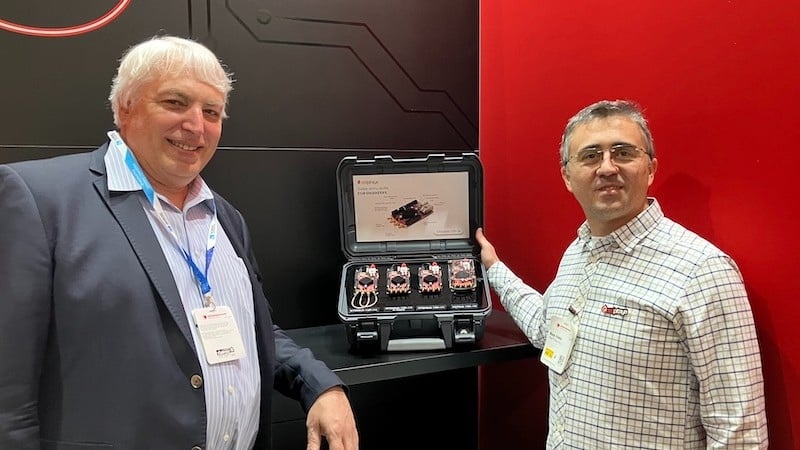
At Embedded World, Red Pitaya's Nicu Irimia shows Jeff Child the STEMlab 125-14 Gen 2.
With enhancements across power delivery, RF signal integrity, memory capacity, and synchronization architecture, the new models build on the company’s established hardware platform while maintaining backward compatibility.
STEMlab 125-14: Many Tools in a Credit-Card-Sized Platform
Red Pitaya's STEMlab 125-14 is a credit-card-sized signal acquisition and generation platform. Built on a Xilinx Zynq 7010 system-on-chip, the solution combines a dual-core Arm Cortex-A9 processor with FPGA fabric to support real-time digital signal processing.
The platform incorporates two analog inputs and two analog outputs, each operating at 125 megasamples per second with 14-bit resolution. The device also includes 512 MB of onboard DDR3 RAM and provides microSD card support up to 32 GB for OS and data storage. Users can interface with the board via Ethernet or Wi-Fi and can remotely control experiments or instrumentation setups using Python, MATLAB, LabVIEW, or Scilab.
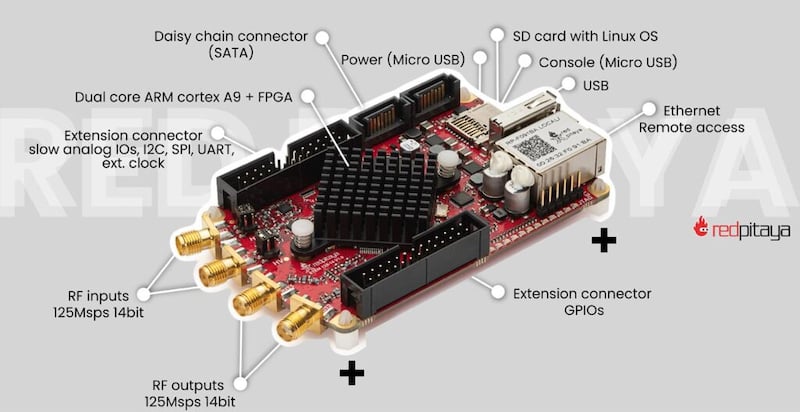
The STEMlab 125-14.
The system architecture enables deterministic dataflow between the processor and the FPGA so the device can execute signal processing tasks such as spectrum analysis, Bode plotting, and logic analysis without external processing. Application support extends to vector network analysis, LCR metering, and data acquisition when paired with external modules. The FPGA can also be reprogrammed to develop and deploy custom data paths or experiment-specific algorithms.
Designed for integration into embedded systems or research setups, the STEMlab 125-14 supports synchronization via external triggers and clocks. It can serve as a DAQ system, NMR spectrometer front end, or part of a multichannel readout in quantum computing experiments.
What's New in Gen 2?
The STEMlab 125-14 Gen 2 platform introduces architectural and interface upgrades over the first generation to meet modern instrumentation demands. Red Pitaya retains the dual-core Arm Cortex-A9 processor and 125 MS/s 14-bit ADC and DAC architecture but introduces enhancements in power delivery, data interfacing, and signal integrity.
For example, the Gen 2 models replace legacy micro-USB ports with USB-C for both power and console connectivity to support higher current draw and robust physical connectors. Despite identical RF input and output bandwidths—60 MHz and 50 MHz, respectively—Gen 2 devices feature improved RF front-end design to reduce cross-talk, input noise, and harmonic distortion.
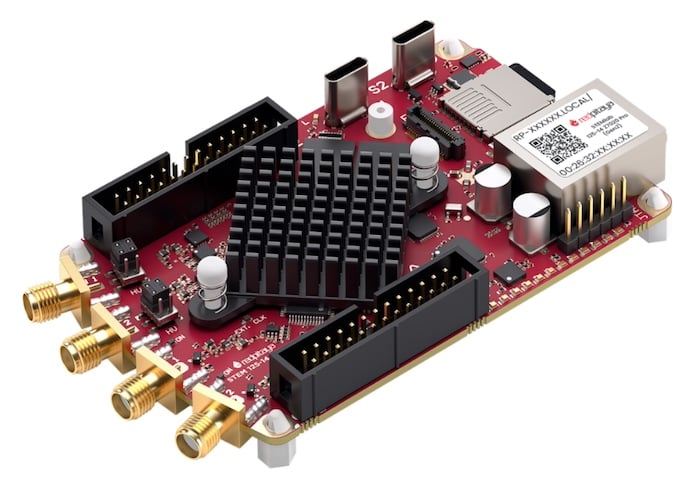
The STEMlab 125-14 Gen 2.
The Pro and Pro Z7020 variants further improve system capability. The Z7020 FPGA doubles the logic resources of the base Zynq 7010 SoC for more complex signal processing and deterministic control. The Pro Z7020 model also increases onboard DDR3 RAM from 512 MB to 1 GB to extend waveform capture depth and processing duration. This model adds eight high-speed differential pairs via the E3 connector, provides extended GPIO functionality, and supports multiple boot options, including QSPI and eMMC, to add flexible system initialization schemes.
Synchronization improvements include dual USB-C daisy-chain connectors capable of 500 Mbps throughput to support multi-device alignment. USB-C also simplifies integration into modern hardware setups. The output voltage range is expanded to ±2 V on high-impedance loads and ±1 V on 50 Ω terminations to match lab-grade analog interface requirements. While internal analog and digital I/O channels remain unchanged, the Pro versions introduce refined power delivery and system boot reliability through the optional E3 interface.
Anticipating Industry Adoption
The Gen 2 series offers a timely response to the industry's demand for flexible and scalable instrumentation across industrial and scientific applications. Red Pitaya hopes that the enhanced performance and modularity of these devices position them to offer engineers and researchers a tool that solves their test and measurement needs.
All product images used courtesy of Red Pitaya.