
 Facebook
 Google
 GitHub
 Linkedin
Rediscovering Colossus, the First Large-Scale Electronic Computer
Colossus was obscured for decades due to government secrecy. Now, it is finally recognized as the world’s first programmable electronic digital computer, even predating the ENIAC.
Colossus, developed by British codebreakers during World War II, was built to crack the Lorenz-encrypted messages of the German High Command. In doing so, it revolutionized codebreaking and paved the way for modern computing.

Colossus (c. 1963), the code-breaking digital computer that played a crucial role in WWII. Image (modified) used courtesy of GCHQ
Despite its significance, the secrecy surrounding its existence kept its story hidden for decades. Today, Colossus is recognized as the first programmable electronic digital computer.
The Birth of Colossus
In the early 1940s, the British faced a formidable challenge: decrypting messages encrypted by the Lorenz SZ40/42 cipher machine, codenamed "Tunny." Unlike the better-known Enigma, Tunny encrypted high-level German communications, requiring a completely different deciphering approach. The complexity of these messages, transmitted via teleprinters, demanded innovation far beyond manual cryptanalysis. Enter Colossus.
The creation of Colossus was a collaborative effort. John Tiltman made an initial breakthrough in 1941 by identifying patterns in Tunny-encrypted messages. In 1942, Bill Tutte deciphered the fundamental structure of the Lorenz machine, deducing its intricate workings without ever seeing the hardware. His work revealed the cipher’s reliance on rotating wheels with changing patterns, which determined the encryption.

A Colossus Mark II computer operated by Dorothy Du Boisson (left) and Elsie Booker (right) of the Women’s Royal Navy. Image used courtesy of GCHQ
Mathematician Max Newman suggested automating the decryption process using electronic methods. Thomas Flowers, an engineer at the Post Office Research Station, took on the challenge. He designed Colossus, combining the concepts of automation, electronics, and logic to produce a machine capable of processing encrypted messages at unprecedented speeds. By December 1943, the first version of Colossus was operational at Bletchley Park, and its improved successor, Mark II, followed in 1944.
A Fully Electronic System
Colossus was a groundbreaking machine that introduced technologies that would influence the future of computing. Its design was fully electronic, relying on over 2,000 thermionic valves (vacuum tubes) for logic operations. This made it far faster and more reliable than earlier electromechanical devices.
Colossus was also incredibly fast. It could read punched paper tapes at 5,000 characters per second, significantly faster than its predecessor, the Heath Robinson machine. This speed allowed it to process enormous amounts of data in real-time, a crucial advantage in breaking Lorenz-encrypted messages.
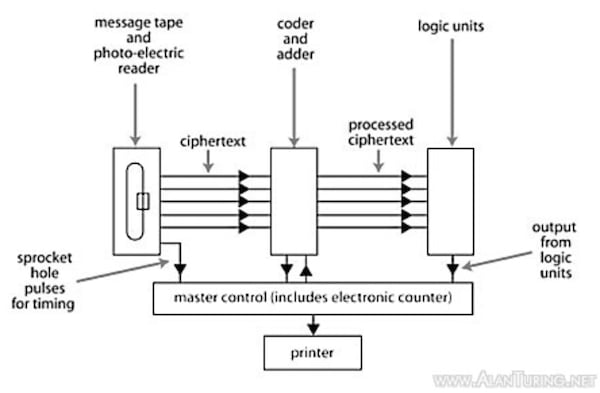
An adapted sketch of Colossus by Thomas H. Flowers, creator of the computer. Image used courtesy of AlanTuring.net and Jack Copeland
Although not programmable in the modern sense of the world, Colossus could be reconfigured through plugboards and switches. Operators could set it up for different tasks, making it adaptable to a variety of codebreaking scenarios. Colossus introduced parallel processing, using a shift register to perform multiple comparisons simultaneously.
Colossus used thyratron valves to generate and store wheel patterns electronically. This eliminated the need for mechanical storage systems and was an early example of electronic memory, a key component of later computers.
A Colossal Impact on the War
The operational success of Colossus had an immediate and profound impact on the Allied war effort. Before Colossus, breaking a Tunny message could take weeks, rendering the intelligence obsolete by the time it was usable. With Colossus, this process was reduced to hours.
One of its most significant contributions was during the planning of the D-Day invasion in June 1944. Colossus decrypted German messages detailing troop movements, allowing Allied commanders to plan their strategy with unprecedented accuracy. This intelligence saved countless lives and played a crucial role in the success of the invasion.
Colossus also influenced the development of post-war technology. Its success demonstrated the potential of electronic computing, inspiring future developments. However, due to the secrecy surrounding its existence, its impact on the broader computing field was limited for years. Instead, other projects like ENIAC received public recognition despite being built later.
Colossus’ legacy was obscured for decades due to government secrecy. After the war, eight of the ten machines were destroyed, and the remaining two were dismantled in the 1960s. Those who worked on Colossus were sworn to secrecy, and official records were destroyed.
A Forgotten Giant Reborn
It wasn’t until the 1970s that the story of Colossus began to emerge, thanks to the efforts of researchers like professor Brian Randell. By then, the historical narrative of computing had largely been shaped by other machines. Colossus was finally recognized as the world’s first programmable electronic digital computer, predating ENIAC and other early systems.
_reconstructed_a_Colossus_Mark_II_.jpg)
A team led by Tony Sale (right) reconstructed a Colossus Mark II at Bletchley Park. Here, in 2006, Sale supervises the breaking of an enciphered message with the completed machine. Image used courtesy of Wikimedia Commons (CC BY-SA 3.0)
Efforts to honor Colossus began in the 1990s. Tony Sale, inspired by the rediscovery of its history, led a team to reconstruct the machine using declassified information and surviving components. The result was a fully functioning replica, now displayed at the National Museum of Computing at Bletchley Park.
Today, Colossus is celebrated as a landmark achievement in computing and a testament to the ingenuity of its creators. In 2024, new images and information were released to commemorate its 80th anniversary, shedding further light on its design and impact. Its story continues to inspire researchers, engineers, and historians, serving as a reminder of how innovation can thrive even under the most challenging circumstances.









Tommy Flowers was a genius of the first rank!
Hats off to the late Tony Sale.
Well worth a visit.
Musk has named his supercomputer at his xAI complex in Memphis, Colossus.
Calling this a programmable computer is really a stretch—kinda like saying your car is programmable because you can change from winter to summer tires, add a roof rack, or reposition the seats. Still, it did it’s job and was a step along the way.