Facebook
 Google
 GitHub
 Linkedin
Research Shorts: Medtech Targets Sleep, Speech, Strength, and More
Recent research explores healthcare diagnosis, monitoring, and rehab—from the "world's smallest programmable microbots" to wearables that restore speech to stroke patients.
Recent research announcements from academic labs continue to push medical technology toward earlier diagnosis, less invasive sensing, and more patient-centered care.
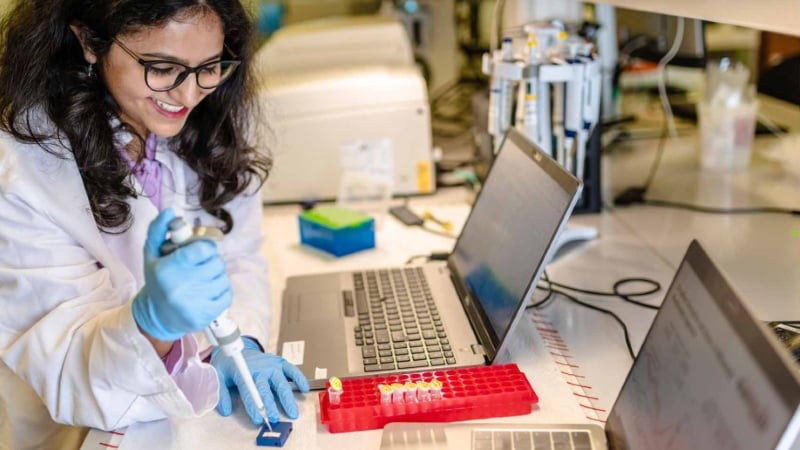
University researchers conduct laboratory testing of next-generation medical technologies. Image used courtesy of the University of Texas at Dallas
This edition of Research Shorts highlights several developments, such as wearable health monitoring, microscale robotics, neural interfaces, and assistive communication devices. Each project addresses a specific limitation in current clinical practice and outlines a path toward future validation and deployment.
University of Arizona: AI Wearable Targets Early Frailty Detection
Researchers at the University of Arizona have developed a wearable device designed to identify early signs of frailty in elderly adults before serious events such as falls or hospitalization happen. Frailty is often diagnosed only after an incident, which in turn limits opportunities for preventative intervention.
The prototype is a 3D-printed mesh sleeve worn around the thigh that measures characteristics such as acceleration, symmetry, and step variability. Artificial intelligence then analyzes this data in real time and transmits summarized results, reducing data transmission by nearly 99%.

The wearable device on the subject’s leg (a) and a functional block diagram illustrating the subsystems enabling the device's functionality over extended durations (b). Image used courtesy of Nature
The system operates using edge AI and supports long-range wireless charging. This feature eliminates the need for frequent user interaction. One of the main hurdles the team encountered was balancing high-fidelity monitoring with battery life and data management. The researchers reduced power consumption and avoided reliance on high-bandwidth connectivity by performing inference directly on the device.
Next steps include expanded clinical studies to validate performance across larger and more diverse patient populations.
University of Pennsylvania: Microscopic Robots Operate Autonomously at Cellular Scale
Engineers at the University of Pennsylvania have created what they describe as the world’s smallest fully programmable, autonomous robots. The robot is barely visible to the naked eye and operates without tethers, magnetic fields, or external control systems. Each microrobot measures approximately 200 × 300 × 50 μm and is powered by light. At this scale, conventional robotic locomotion strategies fail due to dominant forces such as drag and viscosity. The research team addressed this challenge by developing propulsion methods suited to microscale physics.

A penny dwarfs the researcher's microrobot. Image used courtesy of the University of Pennsylvania
Integrated microelectronics enable the robots to sense environmental conditions, such as temperature, and adjust their movement accordingly. The robots are fabricated at extremely low cost and can operate for long periods. Potential applications include medical diagnostics at the cellular level and the assembly of microscale devices.
University of Texas at Dallas: Sweat-Based Sensor Monitors Sleep Hormones
Researchers at the University of Texas at Dallas teamed up with biotech company EnLiSense. Together, they have demonstrated a wearable sensor that continuously measures cortisol and melatonin through passive sweat. These hormones regulate stress and sleep-wake cycles and are traditionally measured using saliva or blood samples.
The wearable sensor enables non-invasive monitoring for over 48 hours. This allows it to capture circadian rhythms that are otherwise difficult to observe. Sweat-based measurements closely matched salivary results in validation studies involving 43 participants.
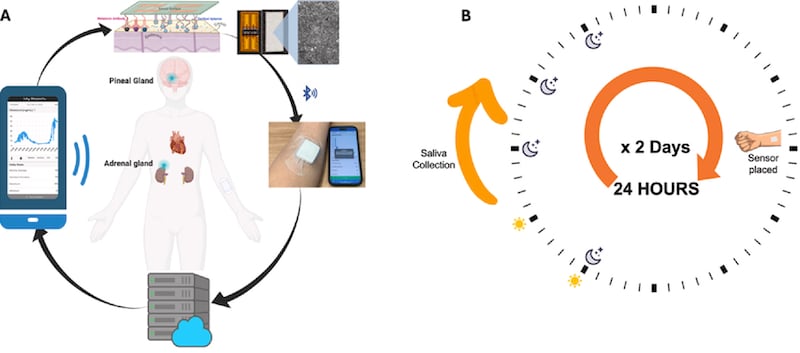
The wearable passive sweat biosensor system (a) and the 48-hour monitoring protocol, during which sweat was continuously collected while saliva samples were obtained periodically. Image used courtesy of Science Direct
One of the obstacles the team faced was translating raw sensor data into actual, meaningful physiological insights. The team developed analytical models to interpret hormone trends over time and assess circadian alignment. The technology could support improved sleep assessment and personalized health monitoring.
Carnegie Mellon: Stainless Steel Neural Probes for Brain Recording
Engineers at Carnegie Mellon University have developed a new class of neural probes made from stainless steel rather than silicon. Traditional silicon probes are brittle and can fracture during deep-brain insertion, posing major risks during surgery.
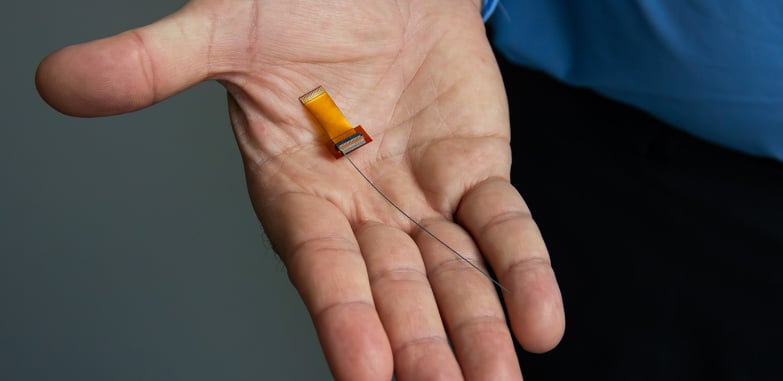
A stainless-steel neural probe enables high-density brain recording with improved mechanical robustness. Image used courtesy of Carnegie Mellon University
The Carnegie Mellon team microfabricated stainless steel probes, referred to as “steeltrodes,” using a process that enables high-density electrode integration while maintaining mechanical toughness. The probes can reach deep brain structures with minimal tissue damage and support both research and clinical applications.
The team developed new planarization and multilayer fabrication techniques to overcome challenges in microfabricating fine features on steel. In vivo tests demonstrated high-quality neural recordings and resistance to fracture. Future efforts will focus on scaling production and validating long-term use in clinical environments.
University of Cambridge: Wearable Device Restores Natural Speech After Stroke
Researchers at the University of Cambridge have introduced a wearable communication device designed to help stroke patients with dysarthria regain fluent speech. Many existing assistive technologies rely on slow input methods or invasive implants.
The device, called Revoice, is worn as a soft choker and uses ultra-sensitive sensors to detect subtle throat-muscle vibrations and heart rate signals. AI models decode silently mouthed words and input emotional and contextual cues to generate full sentences. In early trials, the system achieved very few errors with sentences and significantly improved user satisfaction.
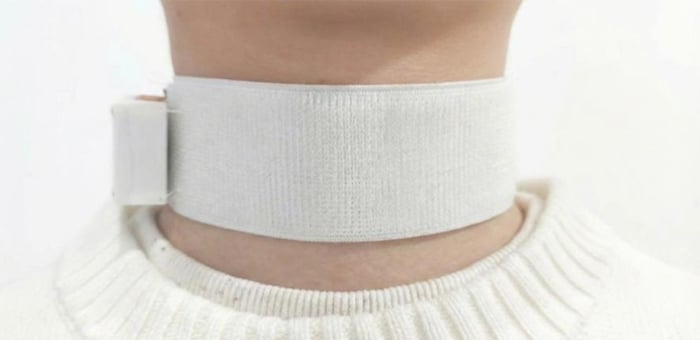
A soft, wearable choker captures subtle throat vibrations to help stroke patients communicate naturally without invasive implants. Image used courtesy of the University of Cambridge
The device may reduce physical and cognitive strain on users while maintaining expressive communication. The research team plans to expand clinical trials and explore multilingual support to develop a practical, non-invasive communication aid.