Facebook
 Google
 GitHub
 Linkedin
Rohm Unwraps High-Precision Optical Sensor Leveraging VCSEL Technology
The compact analog photoreflector targets high-speed object and line detection.
Rohm has announced the RPR-0730, an analog reflective optical sensor designed to deliver high-precision detection of fast-moving objects. As equipment throughput rises, systems need better optical feedback to maintain accuracy at higher speeds. Conventional LED-based reflectors are limited in directionality and response time.
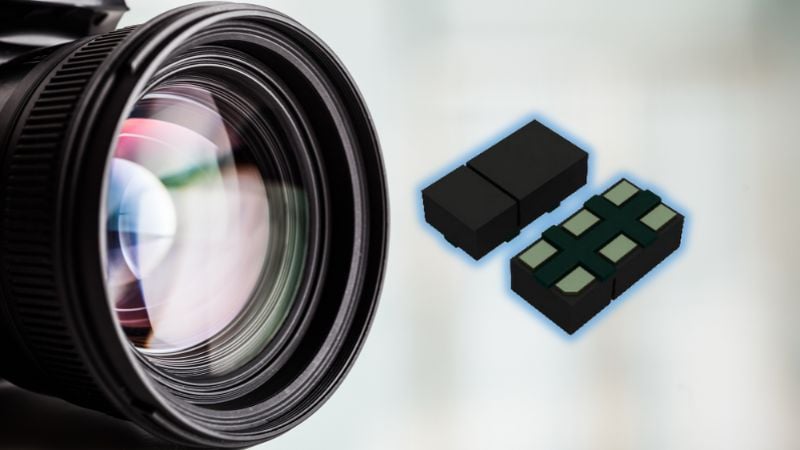
The RPR-0730 can be used for MFPs, label printers, digital cameras, industrial equipment, and more.
As a result, the industry is turning toward sensors with faster electrical response and improved ambient-light rejection. Rohm believes this new product will put these improvements into engineers’ hands.
Rohm's New Fast, Precise Optical Sensor
The RPR-0730 (datasheet linked) is an analog photoreflector built around a 940-nm vertical-cavity surface-emitting laser (VCSEL) transmitter paired with a phototransistor receiver. Built to improve on the RPR-0720 device, the RPR-0730 comes in an ultra-compact 2.00 mm x 1.0 mm x 0.55 mm package and uniquely offers an analog output. Rohm claims the analog output differentiates varying object reflectivity and distance, which contributes to higher sensing granularity and a continuously proportional output response.
Important performance specifications include a maximum detection distance of 10 mm and a collector current of up to 5.7 mA when an object is placed 3 mm from the sensor (IF=4 mA, VCE=5 V). When the reflective object is positioned at 10 mm, the typical collector current drops to 1.17 mA. The device also achieves high detection accuracy with a minimum line width of 0.1 mm at a 1-mm distance, using a standard 90% reflective surface as the target.
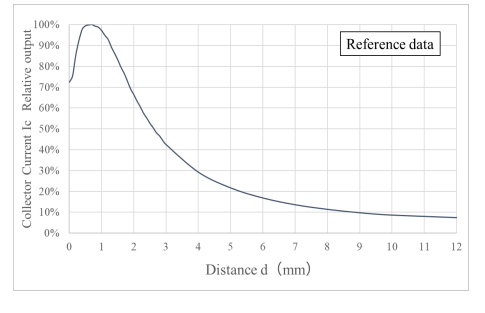
RPR-0730 collector current vs. detection distance. Image used courtesy of Rohm Semiconductor
The VCSEL operates at a forward voltage range of 1.55 V to 2.15 V, and a laser oscillation threshold current up to 2.5 mA. On the phototransistor side, the device exhibits a maximum dark current of 0.1 µA and a saturation voltage of 0.5 V at 0.1 mA collector current.
To suppress the effects of ambient light, the RPR-0730 also incorporates a visible-light cutoff filter and internal micro-slit structures to reduce internal light leakage. The device also meets IEC/EN 60825-1:2014 Class 1 laser safety requirements.
The device's analog output provides a continuous signal variation that's proportional to reflected light intensity. The sensor also delivers a response time of 10 µs and a maximum detection distance of 10 mm. Its typical collector current is 5.7 mA, with a maximum leakage current of 1.1 mA.
The RPR-0730’s narrow optical axis, derived from the VCSEL emitter, enables equipment designers to integrate the device into systems with constrained mechanical tolerances. Rohm also constructed it with a filtering resin that stabilizes the phototransistor output in environments with shifting ambient light conditions.
Understanding VCSEL-Based Reflective Sensing
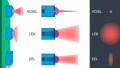
Vertical-cavity surface-emitting lasers are important in reflective object-detection architectures because of their emission profile, wavelength stability, and package-level integration benefits. VCSELs emit light perpendicular to the wafer surface through a short vertical cavity to produce a circular beam with narrow divergence. This geometry helps engineers illuminate small target regions compared with traditional infrared LEDs, whose wider angular spread reduces spatial resolution in reflective sensing configurations.
In reflective systems, the optical axis and intensity distribution determine how accurately a sensor can identify fine transitions in the returned signal. When the emitter’s divergence is low, more of the emitted power returns along a predictable path, yielding cleaner transitions as objects with small features pass through the detection region. These characteristics help reduce the influence of mechanical tolerances and off-axis reflections within host equipment.
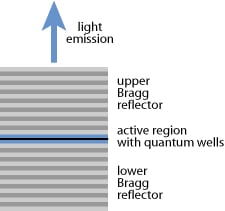
Schematic gain structure of a VCSEL. Image used courtesy of RP Photonics
VCSELs also offer fast switching characteristics, which benefit sensors that require short response times. Their beam coherence and spectral purity improve the receiver’s ability to isolate the intended wavelength when paired with optical filtering elements. This becomes particularly relevant in environments with high ambient-light levels or broadband illumination sources. Because reflective sensing in compact electromechanical systems often suffers from unpredictable optical crosstalk, the stability and directionality of a VCSEL can reduce the variance introduced by ambient conditions and reflective surface textures.
Finally, the combination of compact size and surface-emitting structure allows VCSELs to integrate effectively into miniature package geometries, supporting modern equipment that demands both high performance and reduced component footprint.
Higher Speed and Finer Resolution
As manufacturers seek to maximize throughput without increasing device footprint, components like the RPR-0730 may offer a path forward for scalable system performance.
Related Content