Facebook
 Google
 GitHub
 Linkedin
SiTime Introduces Jamming- and Spoofing-Resistant Precision Oscillator
With an eye on aerospace and defense applications, SiTime designed the new oscillator—announced today—with multi-layer reliability for GNSS receivers.
Today, SiTime announced the Endura reliability-focused temperature-compensated crystal oscillator (TCXO), the ENDR-TTT. The Endura ENDR-TTT is used as the local oscillator and clock source within global navigation satellite system (GNSS) receivers. The new oscillator may enable reliable GNSS receiver operation in high-threat environments. SiTime designed the device to resist spoofing and jamming and continue operation in high-holdover times when the GNSS lock drops out.
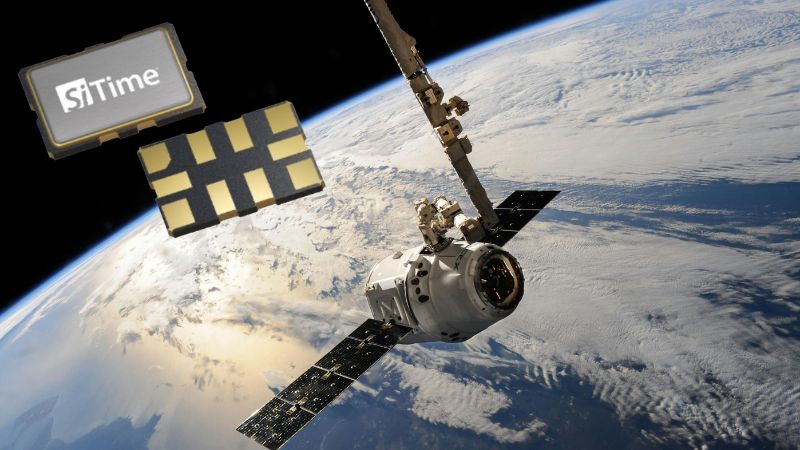
All About Circuits spoke with Piyush Sevalia, executive vice president of marketing at SiTime, to glean more insights about the new oscillator.
Key Features of the ENDR-TTT
SiTime created the ENDR-TTT to raise the bar for ruggedized GNSS timing-dependent applications. The company built the ENDR-TTT for high reliability under both normal and extraordinary operational conditions. It has better shock (g force) survivability, more stable time keeping, and a wide, stable temperature range.
"During holdover, the accuracy of the clock guarantees that the GNSS cannot be spoofed into synchronizing to an adversary signal, because the clock is so accurate," said Sevalia.
Other features include:
- Multi-layer anti-spoofing
- ±50-ppb stability over temperature (FvT)—up to 10x better frequency stability over temperature versus quartz alternatives
- -55ºC to +125ºC operating temperature range
- 30,000 g operational shock—up to 20x better resistance to shock
- 0.004-ppb/g typical g-sensitivity—up to 50x better than quartz alternatives
- ±0.5-ppm 20-year aging—eliminates field recalibration
- Optional I2C/SPI digital pulling capability for system frequency fine-tuning
SiTime also engineered a 20-times longer holdover and 20 times better positioning, navigation, and timing (PNT) accuracy than prior TCXO. Holdover refers to the ability of a clock source to allow the GNSS receiver to maintain PNT accuracy when a satellite loses signal. The improvements in holdover time and PNT make the new oscillator more resistant to dropouts and attacks.

This use case illustrates why longer holdover matters.
The chips will be designed into navigation systems, software-defined radios, smart munitions, drones, autonomous vehicles, edge computing devices, and data center time synchronization systems.
Extended Holdover Accuracy for Threat Mitigation
The extended holdover time in the ENDR-TTT maintains continuity with the original satellite time. While it is not as accurate, it is precise enough that the GPS receiver will keep location and time continuity. The longer a local oscillator can maintain a reasonably synced time, the longer the receiver can maintain accuracy despite spoofing, jamming, or signal loss.
"Imagine a soldier is out in the field and has a location GNSS receiver in his or her backpack—and the GNSS is jammed," Sevalia said. "Well, the soldier should be able to accurately understand his or her location, in spite of the GNSS being jammed. That's what this clock would do: if the GNSS disappears, the system reverts to this local clock as the reference."
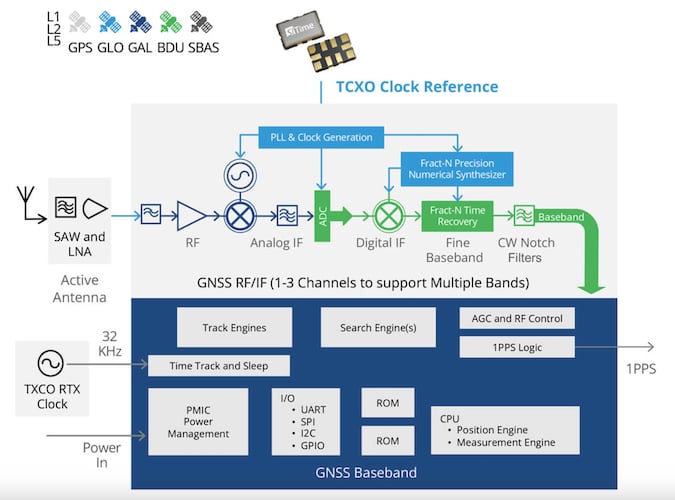
GNSS receiver architecture built around a precision temperature-compensated crystal oscillator (TCXO).
The new SiTime oscillator is designed specifically to be more resistant to natural and manmade disruptions.
GNSS first entered orbit in the late 1970s with navigation as a primary purpose. It now includes the U.S.'s GPS, the European Union's Galileo, China's BeiDou, and Russia's GLONASS. Due to the nature of the system design, however, GNSS has become a valuable worldwide time reference system, too.
GNSS satellites employ extremely precise atomic clocks as a foundation for navigation calculations, and these clocks are now used by many systems to synchronize with global time. Cellular networks, data centers, edge computing systems, industrial installations, power grids, and businesses requiring timestamps all rely on GNSS timing for synchronization. The same reliability built into the ENDR-TTT for navigation also benefits time synchronization applications.
Reliability in High-Threat Environment
GNSS must operate in an environment of increasing threats. In addition to natural interruptions, such as tall buildings, mountains, and building structures, sophisticated navigation spoofing and jamming attacks are increasing. Criminal elements can use GNSS as an attack vector on civilian activity, such as air travel, shipping, and truck and rail transportation. Data centers and Internet of Things (IoT) devices can also be compromised with GNSS attacks.
The chips are designed to safeguard such navigation systems, software-defined radios, smart munitions, drones, autonomous vehicles, edge computing devices, and data center time synchronization systems.
“Even when GNSS is jammed and not available, the timing is so accurate that the equipment still knows its location to a high degree of accuracy,” said Sevalia.
SiTime is now offering ENDR-TTT in sample quantities and plans full production in the first quarter of 2026.
All images used courtesy of SiTime.