Facebook
 Google
 GitHub
 Linkedin
Targeting High-Performance Designs, STMicro Unveils First 18 nm MCU
Announced today, the new generation of high-performance MCU leverages an Arm Cortex-M85 fabbed with silicon on insulator technology to create, at 800 MHz, the fastest STM32 ever shipped.
Today, STMicroelectronics announced the STM32V8, their newest generation of AI-capable high-performance MCUs. The new MCU is designed to give top-end embedded developers a path forward to increased performance, better security, and more memory.
The STM32V8 is powered by an Arm Cortex-M85, the highest performing M-series, running at 800 MHz. It comes with up to 4 MB of phase-change non-volatile memory (PCM), up to 1.5 MB RAM, a solid security feature set, and broadly compatible communications. It achieves harsh-environment rigidity through the use of an 18nm silicon-on-insulator (SOI) fab process.
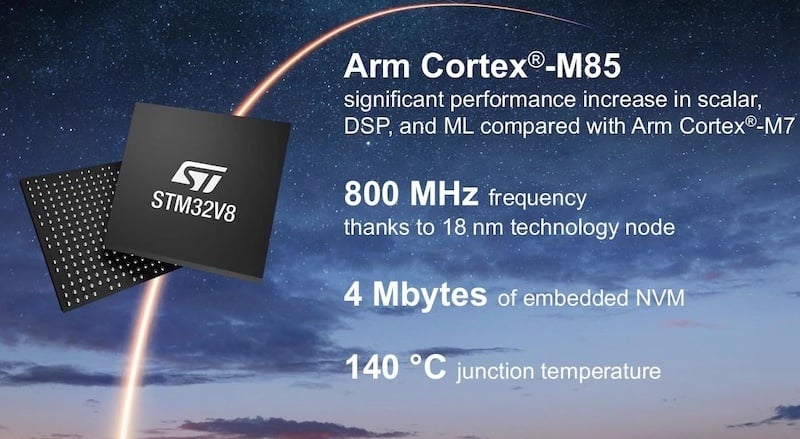
The STM32V8 is the fastest STM32 to date.
Performance Boost at the Top
All About Circuits recently joined Patrick Aidoune, Group VP and Division General Manager for the General Purpose and Automotive MCU Division at STMicroelectronics, for a briefing on the new MCU family. In speaking about performance increases over previous STM32 flagships, Aidoune stated that just by upgrading the Cortex-M85, the new MCU gets a 20% performance improvement in scalar math for real-time control applications. Applications leaning on DSP functionality can see a 300 to 400% increase in performance.
He explained that the use of 18 nm SOI enables the 800 MHz clock speed and greater non-volatile memory (NVM) capacity. The phase-change NVM is based on Fully-Depleted Silicon-On-Insulator (FD-SOI). PCM on FD-SOI enables a smaller cell construction than prior generations of NVM.
Aidoune said their new 18 nm PCM delivers a smaller NVM unit than 14 nm process nodes with more conventional NVM construction. The 4 MB of NVM is arranged in two banks which allows for easier over the air (OTA) field upgrades.
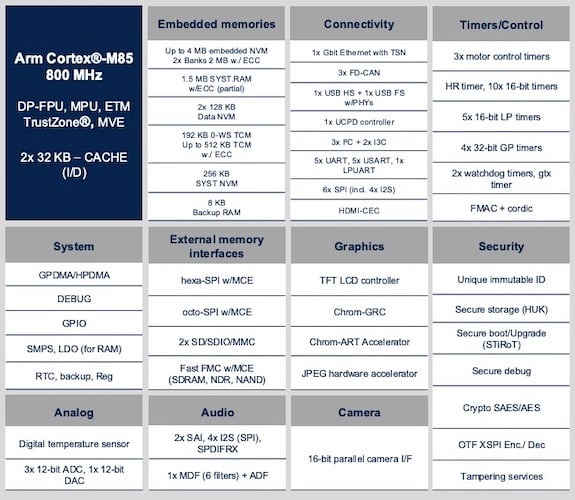
STM32V8 block diagram
Key features include:
- USB high-speed & full speed with PHYs, FDCAN, I3C, SPI, UART
- 1 Gbit Ethernet with TSN for real-time industrial networking
- Graphics: Chrom-ART Accelerator, JPEG codec, TFT LCD controller
- PSA Level 3 & SESIP3, STM trust framework and hardware cryptography
High-Powered Edge AI
The STM32V8 anchors its AI capability with Arm Helium M-profile Vector Extension (MVE) capability. Helium is an Arm math architecture based on packed single instruction multiple data (SIMD) and single-element scalar instructions for integer and floating-point numbers. Helium covers 8-bit through 64-bit integer operations and 16 and 32-bit floating-point arranged in 128-bit vectors.
Helium is designed to bring enhanced machine learning (ML) and digital signal processing (DSP) capability to high-performance microcontrollers. Arm wraps the MVE into a set of libraries and code generation tools for C and C++ development.
Rugged and Secure
The SOI base allows for increased radiation resistance and high junction temperature (up to 140° C), giving more reliable operation in harsh environments, such as low-Earth orbit space and industrial installations.
Aidoune gave an example: “The STM32V8 has been selected by SpaceX for a high-speed connectivity system in the Starlink satellite network. They have designed a laser that allows them to connect any third-party satellites or space stations to their Starlink network, basically enabling high-speed datalink over long distances.”
He further said that with the STM32V8, Space-X “can reach up to 25 gigabit per second connectivity in space over distances up to 4,000 kilometers.” The selection validates the robustness of SOI and ST’s 18 nm process.
ST did not neglect security. The new chip includes the STM32 Trust framework and the latest cryptographic algorithms and lifecycle management standards. The chips are designed for PSA Certified Level 3 and SESIP certification and compliance with the new Radio Equipment Directive (RED) and incoming Cyber-Resilience Act (CRA) standards.
ST Also Announced Their MCU-Targeted Model Zoo
In addition to the MCU announcement, ST introduced an upgraded AI model zoo for their edge-AI capable product line. ST stated that with the new additions, they have the largest MCU industry AI model zoo. A model zoo is a collection of pre-trained AI models covering a wide variety of AI applications.
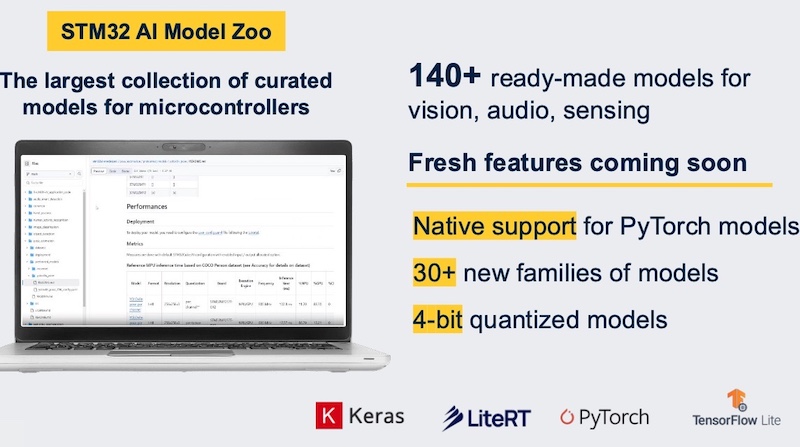
ST’s upgraded STM32 AI Model Zoo
The models are designed to fit within ST’s AI-capable MCU portfolio to speed edge AI development. According to ST, the zoo has more than 140 models covering applications such as: “vision, audio, and sensing to be embedded in equipment such as wearables, smart cameras and sensors, security and safety devices, and robotics.”
ST’s model zoo supports PyTorch, Tenser Flow, RSCI frameworks, LiteRT, and Onex format model development. Aidoune concluded by stating: “The goal we have is to make this model zoo platform that speaks to all experience levels so that all engineers can master their machine learning application on an STM 32 embedded system.”
All images used courtesy of STMicroelectronics.