Facebook
 Google
 GitHub
 Linkedin
STMicro Unwraps Low-Power Image Sensors for Always-On Designs
New BrightSense global-shutter sensors reduce power consumption by 10x for continuous sensing in battery-constrained wearables.
STMicroelectronics recently announced the VD55G4 and VD65G4, a new generation of ultra-low-power, global-shutter image sensors for always-on vision in battery-powered devices. With monochrome and RGB color options and a dedicated detect-and-wake architecture, the new devices aim to bring continuous video streaming to personal electronics.

ST cites smart glasses, XR, wearables, personal electronics, and laptops as size-constrained applications that may benefit from the new sensors. Image used courtesy of STMicroelectronics
VD55G4 and VD65G4
STMicroelectronics offers the VD55G4 and VD65G4 as two variants of the same platform, differing primarily in color capability. Both devices share a 3D-stacked 65-nm/40-nm architecture that delivers 0.56 megapixels (804 x 704) of resolution within a compact 2.73 x 2.16 mm2 die footprint.
Where they diverge is in spectral sensitivity: the VD55G4 provides monochrome imaging optimized for the visible to near-infrared (NIR) spectrum, while the VD65G4 features an RGB Bayer color filter to support standard color applications.
According to STMicroelectronics, both sensors include back-side illumination (BSI) and, the company claims, the industry's first 2.16-µm, global-shutter pixel to capture sharp images of moving objects without the distortion typically associated with rolling-shutter sensors. The sensors maintain a dynamic range of 68 dB and support high-speed capture up to 184 frames per second (fps) at full resolution, or up to 480 fps at QVGA resolution.
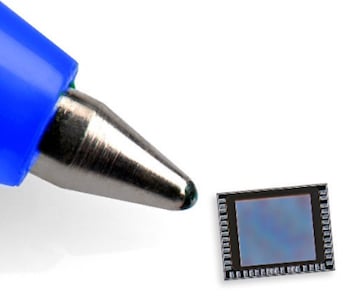
Relative size of ST’s new image sensor, compared to a ballpoint pen. Image used courtesy of STMicroelectronics
To minimize energy consumption, STMicroelectronics implemented a specialized auto-wake-up feature that consumes 1 mW to 2 mW during sleep-monitoring modes. That same auto-wake-up block integrates on-chip image enhancement—autoexposure, noise reduction, and defective-pixel correction—so the sensor can condition its output without drawing on host resources. A dedicated low-frame-rate autoexposure mode extends this further by precomputing exposure parameters on-sensor, reducing the burden on the host CPU or NPU.
For system integration, designers can choose between a single-lane MIPI CSI-2 interface, SPI, or I3C, giving the sensors broad compatibility with the low-power microcontrollers and cost-effective SoCs common in edge and embedded applications.
Global Shutter Technology in Edge AI
Global shutter technology functions by exposing every pixel in the image sensor simultaneously, rather than scanning the scene line by line. The result is that every part of the image represents the same moment in time. In traditional rolling-shutter systems, the time delay between the top and bottom rows of pixels can result in jello effects or skewed lines when the camera or the subject moves quickly. By eliminating these temporal artifacts, global shutters provide the mathematically accurate spatial data required for computer vision algorithms to perform precise motion tracking and object recognition.
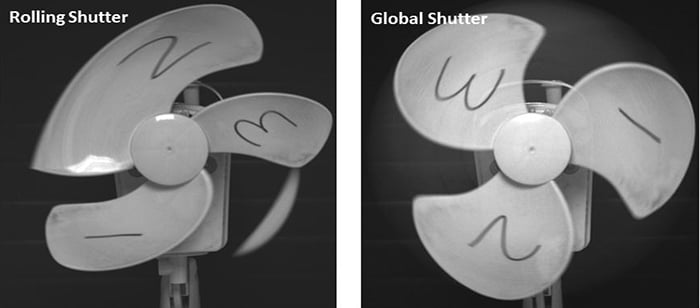
Example of a rolling-shutter vs. a global-shutter image. Image used courtesy of Oxford Instruments
In the context of edge AI, the detect-and-wake capability relies on the sensor's ability to process basic scene statistics without waking the main system. The sensor achieves this through background subtraction and frame statistics outputs, such as 4x4 programmable grids that monitor for changes in light or movement. When it detects a predefined threshold of change, it issues a hardware trigger to the host processor.
The high-power AI inference engine, therefore, consumes energy only when there is actionable data to process. ST says this feature extends battery life, further supporting all-day operation in devices powered by small batteries or energy harvesting.
Availability and Ecosystem Support
The VD55G4 (monochrome) and VD65G4 (RGB) are currently available to early adopters. STMicroelectronics supports these components with a full ecosystem, including development boards for STM32 and Raspberry Pi, turnkey camera modules, and a software development kit for prototyping.
Related Content