Facebook
 Google
 GitHub
 Linkedin
ST’s New IMU Takes Low-g, High-g, and Everything Between in Stride
The IMU pairs low-g and high-g sensing with edge AI to capture subtle motion and severe shocks in demanding industrial environments.
Industrial IoT developers often face a strange paradox: their systems must be sensitive enough to detect tiny movements yet sturdy enough to withstand serious impacts. Anyone building condition-monitoring gear or safety wearables knows this tug of war. A sensor that can catch a slight vibration usually taps out when a machine takes a sudden jolt, while high-shock sensors tend to gloss over the small stuff that signals early problems. The result is missed events, unreliable datasets, and devices that need more sensors than there’s room for.
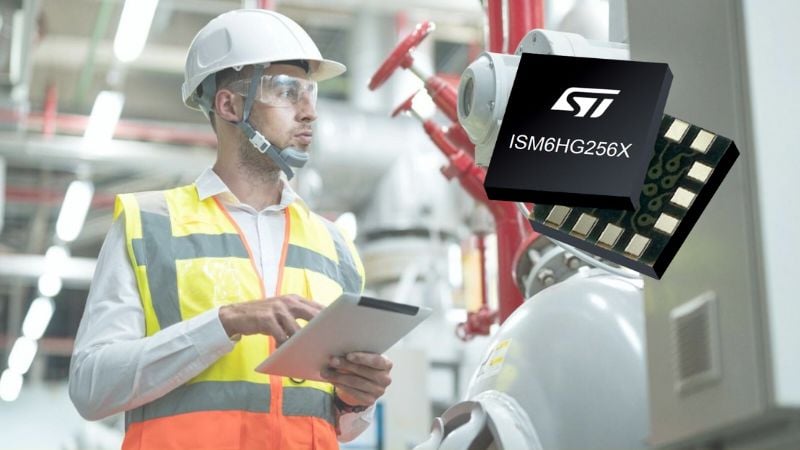
Introducing the ISM6HG256X IMU capable of low and high-g sensing in harsh environments.
STMicroelectronics thinks it can simplify that design puzzle with a single device. The company’s new ISM6HG256X IMU blends two accelerometer ranges, low-g up to ±16 g and high-g up to ±256 g, with a precision gyroscope, all running continuously and independently. It’s built for setups where nothing should escape detection, whether that’s a subtle vibration on aging equipment or a hard impact on a worker’s helmet. And because the device processes much of its own data, systems can get faster alerts without leaning heavily on external processors.
A Sensor Designed for the 'Everything All at Once' Problem
Sensors are almost guaranteed to be exposed to some type of heat, dust, and unpredictable motion patterns that can overwhelm ordinary sensors. The ISM6HG256X (datasheet linked) leans into that challenge with a quad-channel architecture that treats different motion types as distinct data streams. Low-g motion is filtered and processed on its own channel, while high-g shocks run on a separate pathway. Meanwhile, the gyroscope provides angular-rate data for tracking rotation. Because all three operate in parallel, developers don’t have to choose between sensitivity and durability.

The ISM6HG256X has a dedicated core for machine learning processing.
The device also brings its own edge-processing toolkit. It includes a finite state machine for event logic, a machine-learning core for pattern classification, and an adaptive self-configuration feature that lets the sensor adjust its behavior automatically when conditions change. That adaptability is useful in environments where, in one moment, a node is idle on a warehouse shelf and the next it’s bouncing around on a pallet jack. Rather than waiting for a main processor to issue new instructions, the IMU can switch modes on the fly.
Why Edge AI Matters More Than Ever
Many industrial systems have been shifting analytics to the edge to reduce latency and power consumption. But embedding those capabilities directly inside the sensor tightens the feedback loop even further. The ISM6HG256X can classify events ranging from falls, shocks, persistent vibration, or direction changes. This cuts down system energy usage and helps keep battery-powered nodes running longer. And since it can handle both low-g and high-g events, it fills roles that once required multiple dedicated sensors stitched together by layers of firmware.
The embedded sensor-fusion, low-power algorithm adds orientation tracking with just a few microamps of current. That’s particularly useful in asset-tracking tags or compact robotics modules that need positional awareness but can’t spare extra battery capacity. The integrated FIFO, which can compress logged data and store timestamps, helps reduce radio transmission frequency.
Built for Harsh Spots, Tight Spaces, and Long Product Cycles
One recurring complaint in industrial design is the lack of components that survive extreme temperature swings. This IMU ships in a 2.5 mm × 3 mm × 0.83 mm package rated from -40°C to 105°C, making it comfortable in places most people wouldn’t want their electronics or their fingers. It fits into compact wearables, tiny condition-monitoring pods, and factory-automation modules that already fight for PCB space. ST is also committing the sensor to its long-term availability program, offering at least 10 years of supply, which matters for industries that avoid frequent redesigns.
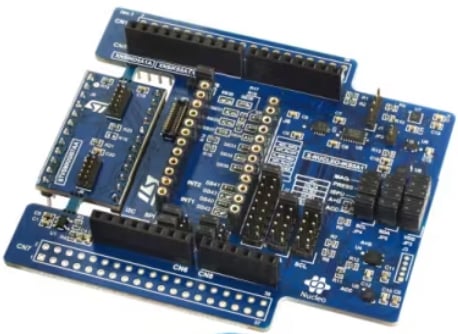
STMicroelectronics has also provided developers with the X-NUCLEO-IKS5A1 expansion board for testing and tuning their applications.
Developers can experiment with the X-NUCLEO-IKS5A1 expansion board and MEMS Studio environment to explore sensor-fusion behavior, fine-tune event thresholds, or test different edge-AI models. The supporting libraries make it possible to build applications ranging from shock-logging “black boxes” to adaptive safety helmets that respond differently to motion, tilt, and impact.
Industrial sensing has always required a mix of precision and toughness, and this IMU may bring both traits under one roof. By merging dual-range accelerometry, gyroscopic data, and built-in intelligence, ST’s ISM6HG256X gives devices a better chance to understand what’s happening around them, even if it’s a faint vibration that hints at trouble or a sudden shock that could be detrimental to the system.
All images used courtesy of STMicroelectronics.