Facebook
 Google
 GitHub
 Linkedin
ST’s Presence Detection for Laptops and PCs Leverages ToF Sensor and AI
The new sensor and embedded AI unlock advanced features in a low-power, privacy-preserving system.
This week, STMicroelectronics introduced its fifth-generation Human Presence Detection (HPD) solution. This latest turkey solution features integrated hardware and software components designed to enhance user experience, security, and energy efficiency in laptops and PC accessories.
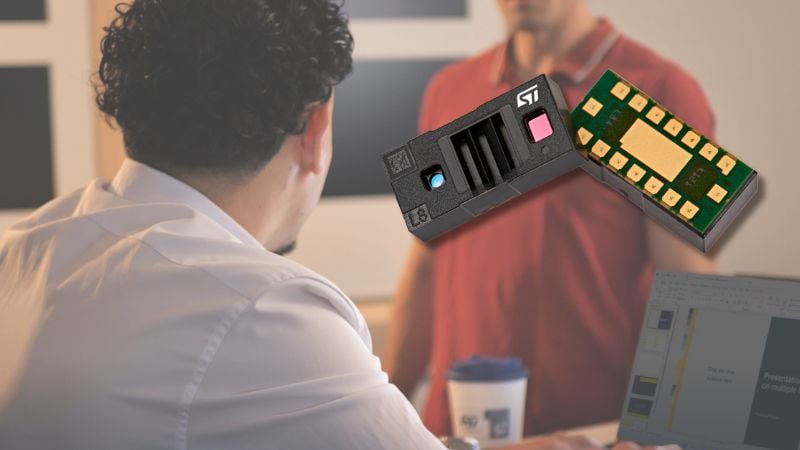
The VL53L8CP for human presence detection.
All About Circuits attended a briefing with STMicroelectronics’ David Maucotel, Herve Grotard, and Olivier Lemarchand to learn more about the new release firsthand.
Hardware, AI, and Microcontroller Integration
The hardware center of the new system is the VL53L8CP, an 8 x 8 multi-zone direct time-of-flight (dToF) ranging sensor with an embedded infrared laser and on-chip photon detection circuitry. The sensor, fabricated using ST’s proprietary 3D-stacked BSI SPAD technology on a 40-nm CMOS node, offers 64-zone spatial depth perception with high signal-to-noise ratio (SNR) per zone, while maintaining a footprint of just 5 mm x 2.5 mm.
“There are only 64 zones, so it's not a camera. There is no image. We cannot see anything in the scene,” Grotard explained. “That’s very important for the user's privacy.”
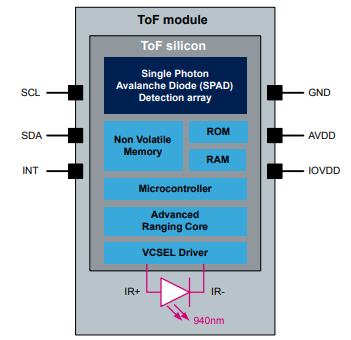
A block diagram of the family’s VL53L8CH ToF module.
ST paired the sensor module with pre-trained AI networks that run on standard PC sensor hubs based on STM32 microcontrollers, eliminating the need for GPUs or AI accelerators. The company offers the entire package as a turnkey solution. It includes ST’s FlightSense ranging hardware, proprietary firmware, precompiled AI models, and integration support across major PC platforms. With no visible image capture, the solution offers complete privacy and enables behind-bezel installation under IR-pass filters.
Context-Aware Detection at Sub-Milliwatt Power
ST’s implementation of AI operates entirely at the edge. Rather than relying on cloud inference or high-throughput image streams, ST’s system uses distance-only data from the VL53L8CP. This data is processed locally on a microcontroller using a suite of four compact, purpose-built neural networks: Presence AI, Head Orientation Recognition (HOR) AI, Posture AI, and Hand Posture AI.
Each network was trained on extensive ST-curated datasets, including global seating and movement datasets contributed by real users over several months. The models contain fewer than 10,000 weights each for sub-millisecond inference on embedded 32-bit MCUs.
“This AI network has been fully designed by ST,” Lemarchand said. “Data capture has been done by ST, the training has been done by ST, and the deployment on PC is also done by ST.”
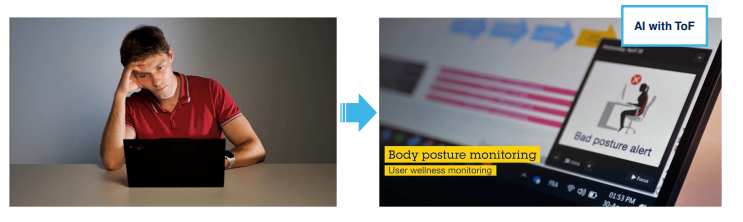
Posture AI can detect a user’s body posture.
Additionally, custom preprocessing pipelines refine the dToF input into low-variance, spatially normalized tensors optimized for microcontroller-friendly inference. The AI stack is further supported by proprietary background filtering, motion mapping, and object classification techniques that differentiate human signatures from static furniture or environmental clutter. Notably, the entire detection loop consumes less than 1 mW in standby operation.
Privacy and Energy-Preserving Features
The HPD platform introduces several new capabilities that exploit the spatial awareness of the dToF sensor and the decision logic of its embedded AI.
Walk-Away Lock detects when a user leaves the field of view and initiates a programmable delay before locking the system and transitioning to a low-power sleep state. This eliminates the five-minute inactivity window typically found in operating systems like Windows, enabling near-instantaneous lockout and reducing screen-on time, thereby mitigating the risk of unauthorized access.

ST estimates that HPD with ToF and AI can save over 20% energy per PC per day.
Wake-on-Attention is an extension of prior wake-on-approach logic. This updated algorithm uses simultaneous posture and head-orientation inference to determine if a user intends to engage with the system. A user standing and speaking nearby will not trigger the wake event unless they are centered and facing the screen. This precision prevents unintentional power-up and spurious login attempts, improving both battery efficiency and user experience.
In empirical tests, the combination of walk-away lock and adaptive screen dimming yields daily energy savings of over 20% per device. ST estimates that global adoption across the 2.6 billion deployed PCs could offset 2.7 TWh annually, equivalent to fully charging 123,000 electric vehicles every day. A fleet-scale deployment at ST’s own 50,000-employee organization would reduce emissions by 118 tons of CO2 per year.
“If everybody is using ST Presence in the world—so something like 2.6 billion PCs—it means that every day we could recharge 123,000 electric vehicles without generating any more CO2,” Grotard said.
Designed for Ubiquity in the PC Ecosystem
STMicroelectronics reports that over 280 PC models have already shipped with previous iterations of its presence detection technology. Since this fifth-generation version requires no additional optical or compute infrastructure and is fully compatible with existing STM32-based sensor hubs, it will integrate easily into Intel and AMD PC architecture. All software and firmware are provided in a unified Software Development Kit (SDK) that OEMs can customize or deploy out of the box.
All images used courtesy of STMicroelectronics.