Facebook
 Google
 GitHub
 Linkedin
Tageos Unveils FlexIC-Based NFC Inlays Using Pragmatic Semi’s Paper Chip
Two new product families pair Pragmatic's PR1301 chip with paper antennas to push smart packaging beyond silicon RFID's cost and material floor.
Tageos has announced two new NFC inlay product families built around Pragmatic Semiconductor's PR1301 flexible integrated circuit, marking what the partners call the world's first commercial RFID lines based on FlexIC technology rather than a conventional silicon die.
The EOS Lite and EOS Zero Lite ranges target high-volume consumer packaging and smart label applications, with the first part, the EOS-932 Zero Lite PR1301, available as a sample by the end of the second quarter (on request) and in volume production from Q3 2026.
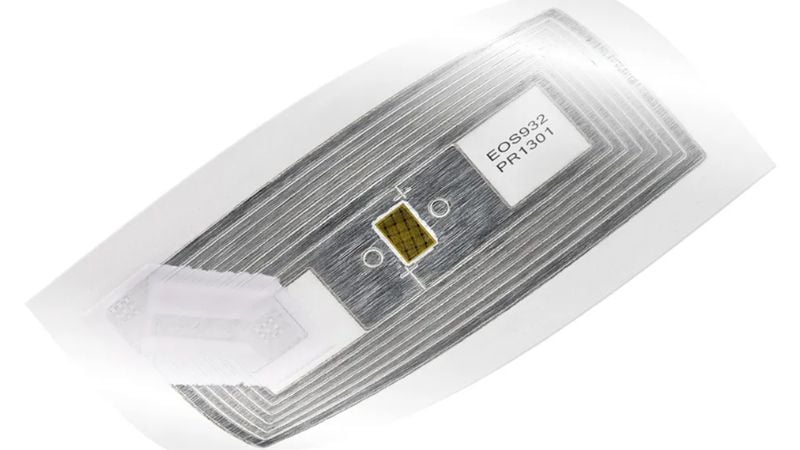
FlexICs are thin, flexible ICs that can be embedded into labels and packaging without the typical “chip bump” of their silicon counterparts.
This launch represents the public arrival of a partnership that Tageos and Pragmatic have been signaling for some time. Pragmatic's NFC Connect product line, anchored by the PR1301 chip, launched in March 2025, has been presented as a sustainable alternative to silicon-based UHF and HF RFID for item-level identification. Tageos, whose existing EOS family has shipped hundreds of millions of inlays, is the first major inlay maker to bring a FlexIC-based product to market under its own brand.
The PR1301
The PR1301 is a 13.56-MHz NFC chip conforming to ISO 15693 and the NFC Forum Type 5 tag specification. It carries 96 bytes of user memory plus a pre-encoded UID, supports a half-duplex 26.48-kbps data rate, and is read by any NFC-enabled smartphone as well as by industrial NFC readers.
Its physical profile sets it apart from silicon: Pragmatic's third-generation FlexIC platform fabricates the chip on a flexible polyimide substrate using thin-film n-type metal-oxide transistors, producing a die roughly 3 mm x 2 mm and only 37 µm thick, with a bend radius of 5 mm.
That form factor makes paper-substrate integration practical, because a traditional silicon die placed inside a label or carton creates a small but tangible bump that interferes with both the appearance and the printing process. The PR1301 is thin enough to disappear into the substrate and flexible enough to survive the curved geometries of bottles, cans, and folding cartons.
Paper Antennas and Sustainability
Where Tageos has gone further than simply substituting the chip is in the antenna substrate. The EOS Zero Lite line replaces PET film, typically used as an inlay carrier, with FSC-certified paper. Combined with the FlexIC die, the result is an inlay assembly whose recyclable mass fraction is substantially higher than that of the conventional NFC inlay it competes with. The EOS Lite family uses similar antenna designs but on a slightly different substrate stack aimed at applications where paper alone isn’t durable enough.
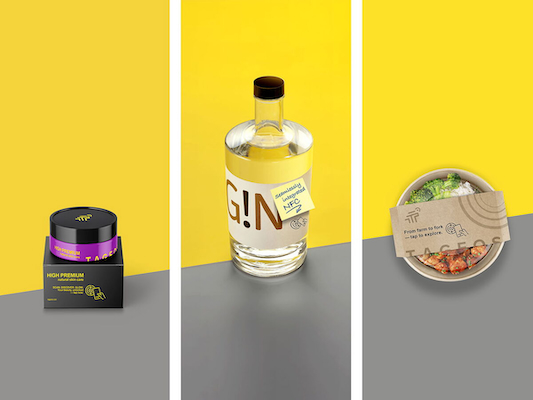
Tageos identified cosmetic folding cartons, premium wine and spirit labels, and smart food packaging as potential use cases for the embedded paper-based NFC inlay EOS-932 Zero Lite PR1301.
Tageos is pitching this directly to brand owners with sustainability commitments, citing applications such as cosmetics, folding cartons, premium wine and spirits labels, and food packaging as the lead application categories for the EOS-932 Zero Lite PR1301. In each case, the value proposition is the same: a packaging inlay that adds smartphone-readable digital identity without altering the carton's appearance or compromising recyclability claims.
Manufactured in the UK
Pragmatic manufactures the PR1301 on 300-mm wafers at its Durham, UK, plant, and Tageos converts the chips into inlays at its Innovation Center of Excellence in Montpellier. Sample EOS-932 Zero Lite PR1301 inlays will be available upon request from the end of Q2 2026, with volume orders beginning in Q3 2026. Additional companion products in the EOS Lite and EOS Zero Lite families are expected later in the year.
Pricing hasn’t yet been announced by Pragmatic, and it will depend heavily on FlexIC's manufacturing costs. These scale differently from conventional silicon, with no requirement for a back-end d-e-cut, attach, or bump process tuned for sub-mm precision. That’s potentially good news for brands considering NFC on every retail unit rather than solely on high-margin pallets and cases; these companies should be able to adopt the inlays at a negligible cost.
All images used courtesy of Tageos.