Facebook
 Google
 GitHub
 Linkedin
Taoglas Upgrades Antenna Tool With AI Modeling, PCB Templates, and More
Taoglas has rolled out a major update to its Antenna Integrator tool, adding AI-enhanced modeling, realistic PCB-shape templates, and new export features aimed at tightening collaboration between electrical and mechanical teams.
Antenna integration has always been one of the most stubborn design bottlenecks in connected hardware. Even as RF front ends, GNSS modules, and IoT chipsets have become more integrated, one fundamental challenge remains the same: antennas don’t behave nicely when compressed into the cramped, oddly shaped PCBs of modern products.
Taoglas, long known for its antennas and RF modules, has increasingly positioned itself as a toolmaker as well. With the latest update to its Antenna Integrator, part of the company’s AntennaXpert suite, the firm is doubling down on AI-driven modeling, layout realism, and rapid RF-performance reporting that aims to bring more antenna expertise into the early stages of design.
Taoglas says Antenna Integrator can now build your design in under 60 seconds.
The company says these enhancements respond directly to the growing complexity of multi-radio IoT products, a need also echoed in ABI Research’s recent market analysis.
AI-Assisted Modeling Meets Real-World Board Shapes
Taoglas describes this release as part of a broader evolution of the Antenna Integrator since its late-2024 launch, adding both intelligence and realism to the core simulation workflow. At the heart of the update is an expansion of what the tool can “understand” about a user’s board.
The new release introduces nine PCB shape templates—circle, arc, triangle, pentagon, hexagon, L-shape, U-shape, stepped, and fully custom outlines—bringing the tool much closer to the unconventional geometries used in wearables, trackers, edge-AI sensors, and embedded industrial hardware. These shapes appear graphically in the web interface, allowing engineers to place antennas in realistic boundary conditions, rather than pretending everything lives on a perfect rectangle.
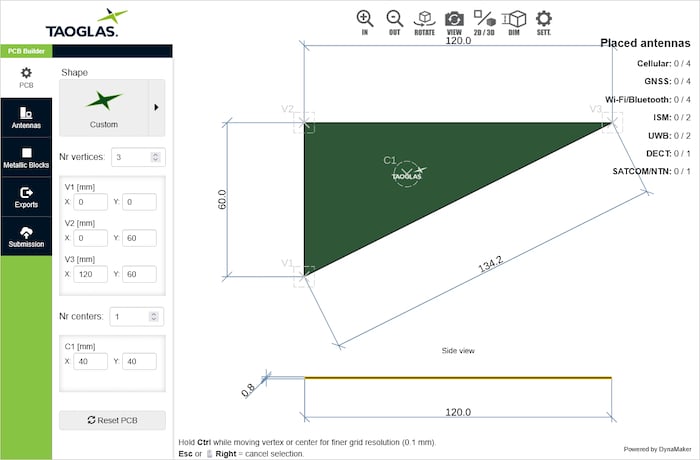
The Taoglas Antenna Integrator demonstrating its custom shape functionality.
The tool also now supports rectangular and cylindrical metallic blocks, which act as stand-ins for batteries, shields, displays, and other parasitic masses of metal that notoriously detune antennas. Taoglas highlights that its underlying models incorporate AI that “learns, adapts, and improves from ongoing real-life use cases,” meaning these parasitic interactions get progressively better reflected in the simulation over time.
This is not a conversational AI assistant. Instead, the AI works under the hood with a continuously updated predictive model trained on thousands of real-world antenna integrations. The result is a kind of RF-behavior co-pilot that behaves like an increasingly accurate predictor of return loss shifts and suitable antenna placements.
A Smoother Path Between EE, ME, and RF Teams
In addition to the modeling enhancements, Taoglas added several workflow-oriented features to reduce friction across design disciplines.
Engineers can now export their project in 3D STEP, DXF, PDF, or image formats, enabling seamless mechanical integration and design documentation. With the new templates and metallic-block objects, these files become more meaningful; mechanical designers can assess enclosure constraints, battery-to-antenna spacing, and detuning risks much earlier in the process.

Taoglas has added new capabilities to its Antenna Integrator as AI-assisted design has picked up steam.
The Antenna Integrator still follows its tried-and-true interactive workflow. Users sketch their PCB, drop in up to twelve antennas, place surrounding components, and then submit the design for review. Taoglas engineers return a performance report within roughly 24 hours, giving designers efficiency estimates and placement guidance before they spin a single board.
This “review-and-simulate” step is a key part of the tool’s identity. Unlike a purely automated solver, Taoglas pairs cloud modeling with real RF engineering oversight, which is a notable hybrid approach in an era where many companies are automating away expertise.
Broader Protocol Support
Alongside the tool enhancements, Taoglas has added three new antennas—NLA.01, DLA.01, and PCS.62—to its library, further broadening the range of cellular, GNSS, Wi-Fi, and UWB designs the tool can model. These additions build on earlier 2025 updates that brought ultra-wideband (UWB) support and expanded performance datasets to the Antenna Integrator.
The company is also leaning on larger industry trends to frame this update. ABI Research projects that global IoT antenna shipments will reach 13 billion units by 2030, a rise fueled by Bluetooth, Wi-Fi, cellular, satellite-augmented IoT technologies, and critically, by AI-enabled design workflows that ease the complexity developers face.
Taoglas, for its part, isn’t only refining design tools. The company has been expanding its hardware portfolio as well, most recently adding six multi-band GNSS RF front-end modules meant to simplify high-precision positioning designs. These modules encapsulate LNAs, filters, and matching networks into 15 mm x 15 mm SMD packages, reducing the RF burden on developers, particularly those designing multi-radio IoT hardware where antenna integration remains a major challenge.
Antenna behavior is messy, and the industry is finally acknowledging that simulation tools must reflect that messiness if they’re going to be useful. With its latest update, Taoglas is pushing its Antenna Integrator further into the workflow of IoT engineering, embracing AI-assisted modeling, realistic board geometries, collaboration-friendly exports, and fast turnaround performance analysis.