
 Facebook
 Google
 GitHub
 Linkedin
Tektronix Launches First Flagship Performance Oscilloscope in Over 10 Years
All About Circuits visited Tektronix HQ in Beaverton, Oregon, to see their new 25 GHz digital phosphor oscilloscope—announced today—featuring lower noise floor and higher ENOB.
When engineers describe their design challenges today, they often circle back to a paradox: the devices they are building are outpacing the test equipment meant to validate them. The limits of oscilloscopes, in particular, can limit innovation in high-speed serial interfaces, artificial intelligence hardware, or particle physics experiments.
To resolve that conflict, today, Tektronix announced its new 7 Series digital phosphor oscilloscope (DPO), the company’s first fresh high-performance platform since the 70000 series launched nearly two decades ago. All About Circuits visited Tektronix's headquarters in Beaverton, Oregon, to see the product and meet the engineers behind it firsthand.
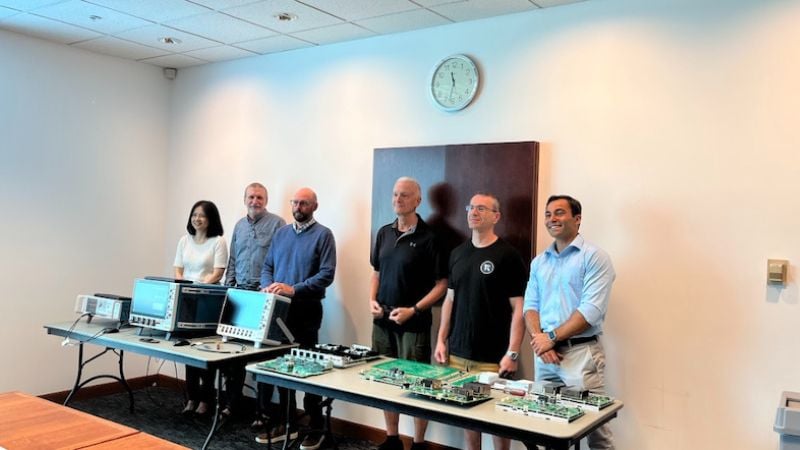
Left to right: Jenny Yang, Forrest Edwards, Mark Briscoe, Tim Bieber, Gene Markozen, and All About Circuits contributor Jake Hertz.
Three Sets of Customers, One Set of Bottlenecks
The 7 Series is what Tektronix calls a performance oscilloscope, a class distinct from the mainstream scopes that populate most labs. Mainstream instruments top out around 10 GHz and rely on ASIC-heavy architectures optimized for efficiency and cost. Performance scopes, by contrast, are designed for extreme fidelity, with higher bandwidths, tighter jitter, and vertical resolution good enough to probe phenomena that often appear only once.
“In the oscilloscope world, we focused on power first, which is mainstream. Now we’re moving to the performance space,” said Forrest Edwards, program manager and principal engineer at Tektronix. “This is just the first of a platform push-up market for us.”
As such, the 7 Series offers bandwidths ranging from 8 GHz to 25 GHz, with a 10-bit ADC sampling at 125 GS/s across all four channels. Random noise levels span from 523 µV at 8 GHz to 1.13 mV at 25 GHz, paired with intrinsic jitter of just 60–70 fs.
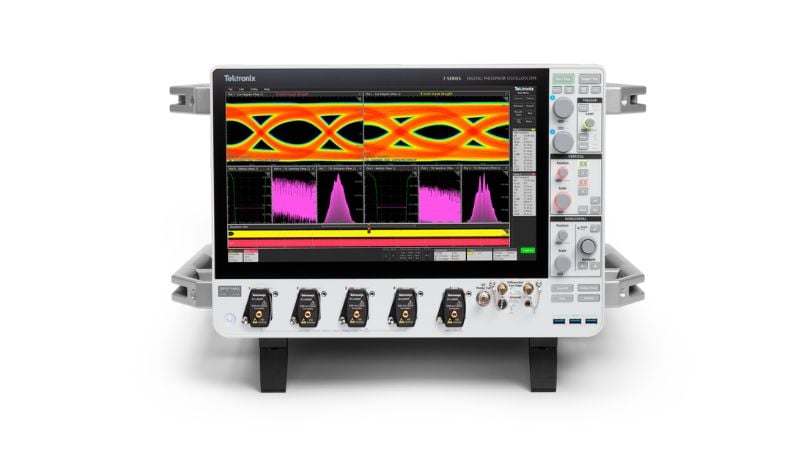
The Tektronix 7 Series scope. Image used courtesy of Tektronix
In that context, the engineering team behind the 7 Series designed the scope with three distinct customer bases in mind.
- High-speed serial developers (PCIe, USB, Ethernet): Here, the pressing issue is jitter and noise margins. Standards keep pushing data rates higher while validation windows stay fixed, so measurement fidelity becomes critical.
- Advanced research labs (fusion projects, linear accelerators): The focus is on single-shot captures of transient events. Effective number of bits (ENOB) matters, as vertical resolution determines whether fleeting phenomena can be resolved.
- Wideband RF customers (aerospace, defense): These customers need scopes that can handle measurements traditionally reserved for spectrum analyzers, with phase noise and error vector magnitude (EVM) performance as the main parameters.
Pushing Signal Fidelity Through Custom Silicon
Architecturally, the foundation of the 7 Series lies in Tektronix’s decision to build its own front-end silicon. Specifically, the scope introduces two new proprietary ASICs: the Tek079 ADC and Tek085 preamp. Both were developed because off-the-shelf components could not deliver the required noise floor or bandwidth.
“There are only two or three companies in the world that can do this, and we had to build our own,” said Mark Briscoe, senior product planner and product marketing manager.
That process spanned more than five years, with ASIC development alone consuming much of the early program timeline.
_and_Gene_Markozen_(right)_with_7_Series_PCBs.jpg)
Tim Bieber (left) and Gene Markozen (right) with 7 Series PCBs.
The architecture choice was equally deliberate on the analog side. Rather than using a track-and-hold design, Tektronix opted for a straight preamp topology, which allowed lower noise while still supporting bandwidths up to 25 GHz. Combined with a 125 GS/s sample rate and 10-bit ADCs, the result is an ENOB of 7.5 bits at 8 GHz, scaling to 6.5 bits at the top end. Each channel supports up to 2 Gpoints of record length, and the timebase is stabilized with <70 fs of intrinsic jitter.
Downstream, the 7 Series diverges from Tektronix’s previous mainstream scopes. While earlier instruments packed most processing into custom ASICs, the 7 Series shifts much of the workload to a high-end Stratix 10 FPGA.
“The FPGA uses more power and a lot more fabric than a custom part would, but it gives us the flexibility we need at these speeds,” said Gene Markozen, hardware/software design engineer.
Each channel produces 62.5 to 125 GS/s—an output so large that it cannot be processed monolithically. As such, the FPGA de-multiplexes this torrent into parallel lanes, applies timing adjustments, and hands it off to a GPU-based backplane system.
QuietChannel: Reducing Noise at the Source
Among the design changes to the new series, one stands out for its architectural novelty. Tektronix integrated what it calls QuietChannel technology into the analog front-end. The technique applies continuous-time linear equalization (CTLE) in hardware to boost high-frequency components before digitization, and then digitally attenuates them afterward. According to the spec sheet, the 7 Series holds noise to 0.10% fs at 8 GHz and 0.23% fs at 25 GHz.
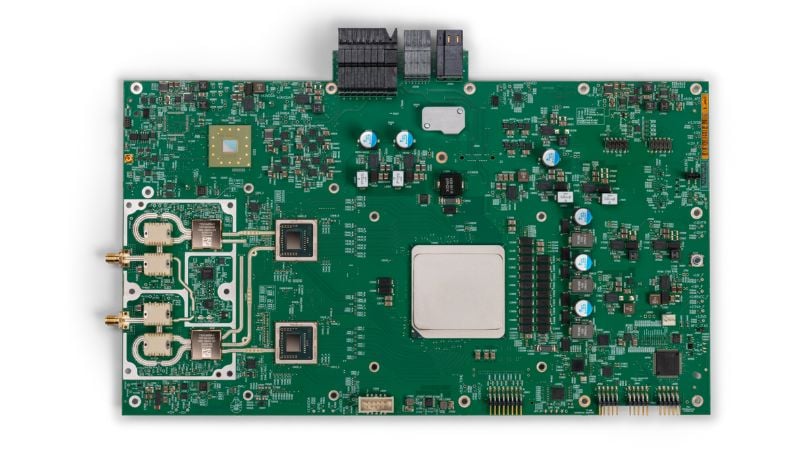
The Tektronix 7 Series acquisition PCB. Image used courtesy of Tektronix
In practice, this means the customer still sees a flat frequency response, but the noise floor is significantly reduced at higher frequencies. It is a rare example of scope vendors leaning on front-end analog tricks rather than post-processing alone to squeeze down noise. For high-speed serial customers, this improvement may spell the difference between seeing the true shape of an eye diagram and seeing the test system’s own limitations.
Speeding Up Compliance and Validation
The other driver for the 7 Series is workflow speed. Engineers working on standards like PCIe Gen7 face exponentially larger test matrices with every generation, yet are not given more time. Bieber relayed the dilemma of one customer as an example of the larger problem: “It takes me three weeks to do one set of tests. How do you speed that up?”
The new platform addresses this on several fronts. Internally, it uses PCIe as part of its architecture to move data more quickly. Externally, it adds a 10-GbE SFP+ port that achieves near line-rate throughput, offering roughly ten times faster data offload than legacy instruments. For compliance engineers, that means days of capture and archive tasks can be reduced to hours.
Tektronix also benchmarked its own measurement throughput, targeting five times faster than the outgoing platform and reaching about four. That is still enough to shift test cycles from multiple weeks to less than one, a tangible difference in development schedules.
A Familiar User Interface in a New Class of Scope
While the hardware front-end consumed years of custom development, the software side presented its own challenge. For the first time, Tektronix unified its mainstream TekScope software platform with a high-performance scope. That means an engineer familiar with a 5 or 6 Series instrument can sit down at a 7 Series and immediately know how to navigate it.
_demonstrates_the_UI_on_the_Series_7_scope_to_Jake_Hertz_(seated).jpg)
Tim Bieber (standing) demonstrates the UI on the Series 7 scope to Jake Hertz (seated).
Software engineering manager Jenny Yang described the task as akin to “building a skyscraper on top of a working train station.” Her team had to refactor the code base to support different hardware platforms while still maintaining quarterly releases for existing scopes. The result, however, is Tektronix’s first performance-class oscilloscope with the same user interface as its mainstream counterparts.
Manufacturing and Reliability
If performance scopes are the “source of truth” for other industries, their own reliability must be unimpeachable. Manufacturing manager Jeff Schuh outlined the gauntlet every unit runs: functional board test, hipot safety screening, low- and high-frequency adjustments, a 48-hour burn-in at elevated temperature with automated power cycling, rapid thermal cycling from below freezing to high temperatures, and final timebase calibration.
_demonstrates_the_UI_on_the_Series_7_scope_to_Jake_Hertz.jpg)
Jake Hertz (in blue) with Jeff Schuh, Tektronix manufacturing manager (in black).
In all, a single instrument requires about 124 hours of testing, not counting assembly. Every test sequence is version-controlled, all measurements are guard-banded to account for equipment uncertainty, and all equipment is traceable to standards. Schuh summarized the philosophy bluntly: scopes must be shipped “rock solid,” because customers rely on them as their ultimate arbiter of accuracy.
Clearing the Bottleneck
The 7 Series DPO marks Tektronix’s first new flagship in over ten years. But beyond a product cycle milestone, it’s a recognition that test equipment itself often sets the pace of industry advancement. Edwards concluded by underscoring that oscilloscopes must exceed their customers’ devices.
“You should probably have to exceed what their actual performance usually tends to be, or they can’t really measure their product,” he said.
In that sense, the 7 Series represents both a new tool and a removed barrier that allows technology to advance at its own pace—not the scope’s.









“...continuous-time linear equalization (CTLE) in hardware…” This pre- & post-equalization technique was first introduced by audio recording engineers [1920s electrical disk recording & 1930s photographic recording in the movie business] to reduce high frequency noise during reproduction. Good to see a century-old technique showing up in the oscilloscope business. What took you so long? LOL Seriously, though, congrats on a fantastic new scope!