Facebook
 Google
 GitHub
 Linkedin
Three New Automotive ICs Target Noise, Precision, and Control
A new wave of automotive ICs may tackle the complex mix of precision sensing, high-speed signaling, and compact actuation inside modern EVs and ICEs.
The latest generation of automotive electronics is defined by density, noise, and precision. Component-level demands have intensified as EV HVAC architectures add more actuators, infotainment networks push into multi-gigabit territory, and powertrains rely on higher-voltage PWM control loops.
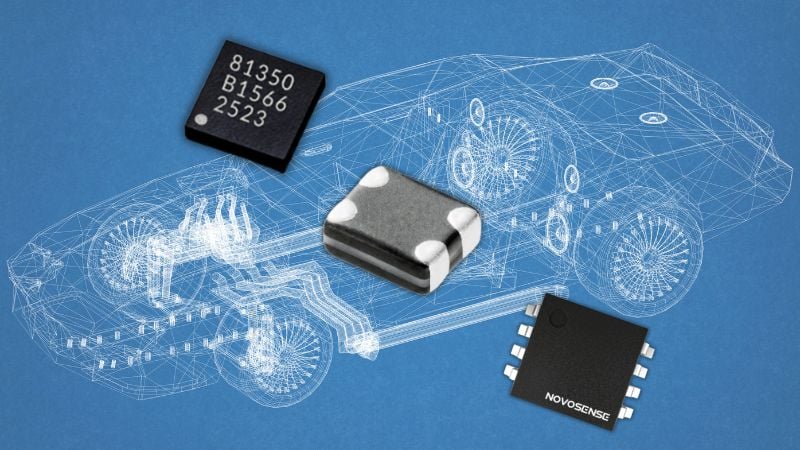
In response, three new ICs—Melexis’ MLX81350 motor driver, Murata’s ultra-high-cutoff common-mode chokes, and Novosense’s NSCSA240-Q current sense amplifiers—illustrate how vendors are reshaping the building blocks of modern vehicle electronics.
Smart LIN Control for 5-W HVAC Actuators
Melexis’ new MLX81350 drops neatly into the growing class of compact, software-driven actuators that now populate EV HVAC systems. Thermal management architectures are becoming more granular, with more flaps, valves, and diverters, and micro-actuators controlling airflow and coolant routing. Engineers are under pressure to shrink module size and cut system noise without increasing BOM complexity.
The MLX81350 addresses those constraints. The fourth-generation, 0.5-A smart LIN motor driver is built on HV-SOI and is pin-compatible with its Gen-3 predecessors. Melexis designed the device to run sensored or sensorless BLDC, stepper, and DC motors up to roughly 5 W. Improvements in stall detection and the addition of closed-loop, sensorless FOC give designers smoother motion and quieter actuation, while the integrated LIN 2.x/SAE J2602/ISO 17987-4 interface simplifies node design for increasingly distributed HVAC networks.

Block diagram of the MLX81350. Image used courtesy of Melexis
Under the hood, the IC features a three-core architecture: an application CPU, a communication CPU, and a coprocessor. It offers split memories, an on-chip charge pump, integrated protection, and a deep peripheral set, including five 16-bit motor PWMs, a sub-microsecond 13-bit ADC, UART/SPI/I²C interfaces, and flexible wake-up modes.
With internal regulators supporting direct 12-V battery input, standby currents in the tens of microamps, and an ASIL-B-aligned design approach, the MLX81350 is positioned as a drop-in actuator controller for EV air-distribution modules, electronic vents, and other small mechatronic loads. At launch, Melexis promised full supply capacity and pin-compatible migration from the MLX81330, further reducing friction for platform teams looking to expand the number of HVAC actuators in next-gen vehicles.
Compact High-Cutoff Chokes for Gbps Automotive Links
Murata has expanded its DLM11C_HH2 family with a new generation of 0504-inch (1.25 mm x 1.0 mm) chip common-mode choke coils designed for the latest wave of high-speed automotive differential interfaces.
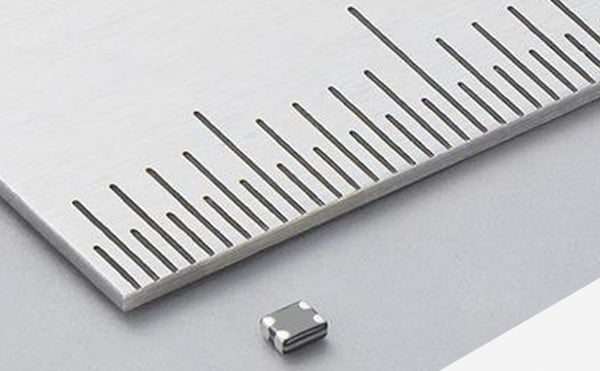
The DLM11C_HH2 series. Image used courtesy of Murata
As USB ports proliferate throughout vehicle cabins and data rates surge toward multi-gigabit USB 3.2, LVDS panel links, SerDes camera backbones, and HDMI distribution, EMC budgets have tightened. Engineers need miniature suppression components that can preserve signal integrity while attenuating common-mode noise above several gigahertz. Murata’s newest device targets exactly that challenge, using proprietary multilayer lamination to achieve high cutoff performance above 7.5 GHz in a footprint suited to dense in-vehicle electronics.
The series’ broader specs reveals a family of AEC-Q200-qualified chokes with common-mode impedances from 12 Ω to 200 Ω at 100 MHz, rated currents up to 100 mA, insulation resistances of at least 10 MΩ, and cutoff frequencies extending into the multi-GHz range. The parts are engineered for harsh automotive environments and validated through high-temperature exposure, temperature cycling, biased humidity, vibration, and shock per AEC-Q200.
High-Voltage Current Sensing for PWM-Dominated Powertrains
Novosense’s new NSCSA240-Q series steps directly into the pain point that has dogged high-voltage PWM systems for years: transient-induced measurement errors. In electric power steering, traction inverters, and industrial motor drives, rapid PWM edges routinely push common-mode voltages tens of volts in microseconds, conditions under which many conventional current-sense amplifiers saturate or misreport.
The NSCSA240-Q series is built for this exact environment, pairing an ultra-wide, common-mode input range of -4 V to 80 V with hardened PWM rejection. Its AC CMRR reaches 90 dB at 50 kHz, suppressing high-frequency events while its proprietary transient suppression architecture cuts output disturbances by up to 80%. During an 80-V, common-mode step, the device settles in under 10 microseconds, allowing control loops to maintain stability even during aggressive switching transitions.

Application diagram of the NSCSA240-Q series. Image used courtesy of Novosense
Where many high-voltage current sense ICs sacrifice precision for robustness, Novosense pushes in the opposite direction. The NSCSA240-Q achieves a typical input offset of only ±5 µV and maintains ±0.1% accuracy from -40 °C to 125 °C, making it suitable for tightly regulated systems like EPS, brake actuators, and high-efficiency motor drives where offset drift can directly impact torque control or thermal behavior.
AEC-Q100 qualification ensures the devices survive long-term deployment in harsh in-vehicle environments. To support platform-level reuse, the series ships with four fixed gain options (20/50/100/200 V/V) compatible with shunts from 10 MΩ to 0.1 MΩ, and comes in SOIC-8 or TSSOP-8 packages designed for dense controller layouts. For automotive and industrial designers facing rising PWM frequencies and shrinking EMC margins, NSCSA240-Q delivers a rare combination of wide dynamic range, transient immunity, and precision.
Related Content