
 Facebook
 Google
 GitHub
 Linkedin
Ventuno Q: The First Fruit of the Arduino-Qualcomm Acquisition Targets AI
Six months after acquiring Arduino, Qualcomm goes big by adding the Dragonwing IQ-8275 AI processor to Arduino's platform.
At Embedded World 2026, Qualcomm announced the newest addition to the Arduino family, the Ventuno Q. The Ventuno Q starts with an Arduino form factor and extends the PC board to create a deployable AI- and robotics-optimized engine. The Ventuno is purpose-designed for stand-alone robotics and AI applications.
“With Arduino Ventuno Q, AI can finally move from the cloud into the physical world," said Fabio Violante, VP and GM of Arduino, now part of Qualcomm. “This platform makes it possible to build machines that perceive, decide, and act—all on a single board.”
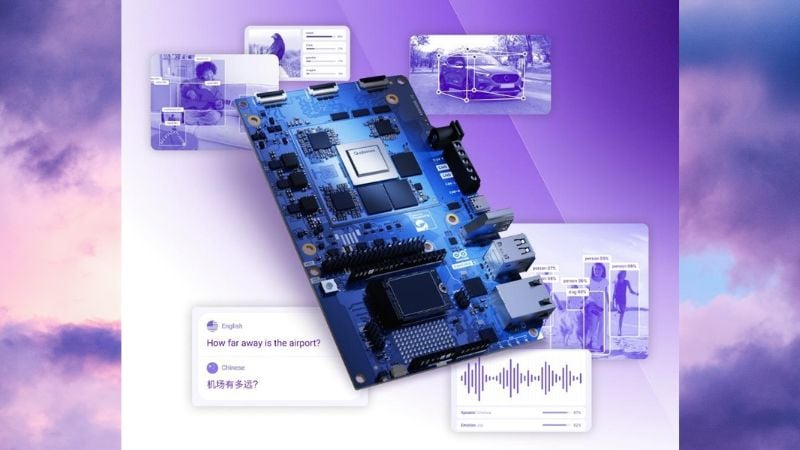
Qualcomm introduces the new Arduino Ventuno.
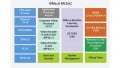
The board is powered by Qualcomm Dragonwing IQ-8275 with 16 GB of LPDDR5 RAM. This processor gives it the power to run the Linux operating system and perform both traditional and generative AI workloads. The Dragonwing is equipped with an NPU accelerator, an octo-core Kryo CPU, Adreno GPU, and Hexagon tensor processor.
“Our goal is to make advanced robotics and edge AI accessible to every developer, educator, and innovator,” said Violante. “Ventuno Q is the natural evolution of Arduino’s mission, and a major step toward bringing real‑world intelligence to everyone.”
The board rounds out local real-time capability with an STM32H5 microcontroller for low‑latency tasks and motor control. The STM32H5 features a 250-MHz Arm Cortex-M33 core with deterministic I/O and multiple CAN-FD interfaces for real-time motor control, sensing, and actuation.
Interface Features
The board prioritizes flexibility for connecting to the outside world. It has the traditional Arduino shield bus, a Raspberry Pi Hat bus connector, new JMEDIA and JMISC UNO carrier headers, a JOMEGA expansion header, and Arduino Modulino connectors. The Modulino is a set of peripherals that mechanically daisy-chain and communicate with the host via the I2C protocol. Ventuno has USB-C, USB-A, Ethernet, +CAN-FD, and an M.2 NVMe storage connector. It supports Wi-Fi and Bluetooth on the wireless front.
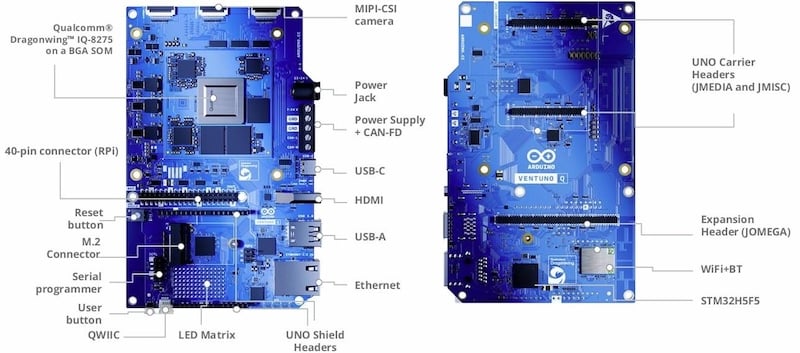
Ventuno I/O set.
For video and vision-intensive applications, it comes with four lanes of the mobile industry processor interface-camera serial interface (MIPI-CSI), display serial interface (MIPI-DSI), dedicated audio inputs, and HDMI out. It also includes the Arduino 8x12 LED matrix display.
AI in the Arduino Family
The IQ-8275 enables edge AI capabilities in the Ventuno, allowing the device to run a variety of AI workloads locally. It supports multiple vision models, including YOLO, MobileNet, and EfficientNet, for image recognition and computer vision tasks.
The platform also accommodates AI-based speech technologies, including speech-to-text, text-to-speech, and keyword detection. In addition, it can run compact large language model assistants, such as Qwen or Llama-derived models, enabling conversational or command-based interactions directly on the device. For sensor-driven applications, the IQ-8275 further supports anomaly detection and time-series models, making it suitable for monitoring and predictive analysis scenarios.
The processor tackles AI with an Adreno GPU, a Hexagon Tensor Processor, and the Kryo CPU. It acts as a neural processor and delivers 40 dense TOPS of AI capabilities. AI models can be implemented in a modular format for easier deployment without sacrificing key capabilities. The AI processing, along with multiple high-speed video channels, enables the Ventuno to run applications that require AI-based video and audio input processing, as well as AI-based response and reaction.
Arduino App Lab
Because these capabilities outclass the venerable Arduino IDE, Qualcomm added the Arduino App Lab to reduce the complexity involved in developing such an advanced system. App Lap supports Arduino sketches and adds Python and AI models for the Ventuno and Arduino UNO Q.
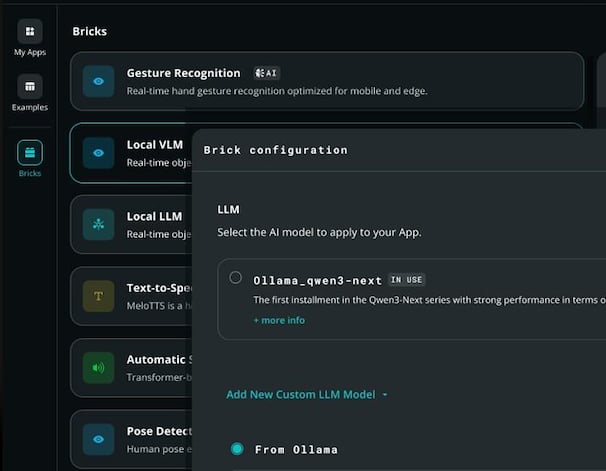
Arduino App Lab combines sketches, Python, and pre-made AI models in the tradition of the original Arduino IDE’s ease of use.
Arduino Goes Big Time
Ventuno was chosen as the name to celebrate 20 years of Arduino. While the now 21-year-old Atmega 8-bit processors still serve as the entry-level Arduino base, the Ventuno reaches into the high-performance world required by professional systems developers. It is still designed to be hobbyist-friendly, while also offering powerful hardware and AI capabilities.
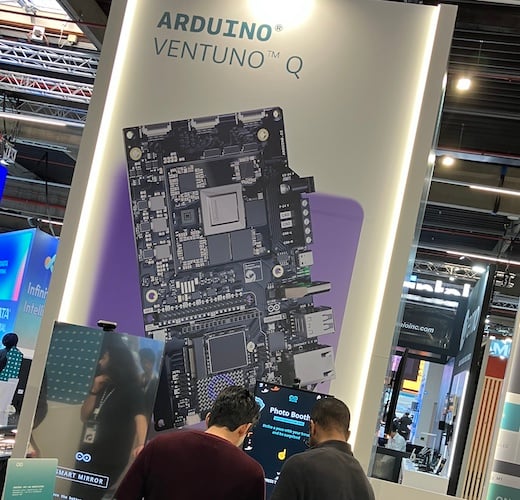
The Ventuno Q on display at Embedded World 2026 last week.
Qualcomm hopes the Ventuno Q will be integrated into applications such as vision-guided robotics, offline voice assistance, industrial inspection, predictive maintenance, and smart environments, among others. The company plans to release the device for less than $300 by the end of Q2.
All images used courtesy of Qualcomm.












Wow interesting