
 Facebook
 Google
 GitHub
 Linkedin
Mathematics for Electronics
Basic Algebra and Graphing for Electric Circuits
16 questions By Tony R. Kuphaldt
-
Question 1 of 16
Many different equations used in the analysis of electric circuits may be graphed. Take for instance Ohm’s Law for a 1 kΩ resistor:

Plot this graph, following Ohm’s Law. Then, plot another graph representing the voltage/current relationship of a 2 kΩ resistor.
Reveal answer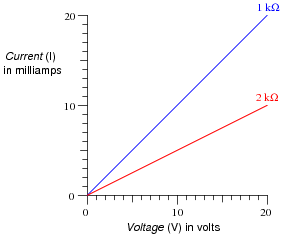
Notes:Ask your students to explain how they plotted the two functions. Did they make a table of values first? Did they draw dots on the paper and then connect those dots with a line? Did anyone plot dots for the endpoints and then draw a straight line in between because they knew this was a linear function?
-
Question 2 of 16
Many different equations used in the analysis of electric circuits may be graphed. Take for instance Ohm’s Law for a variable resistor connected to a 12 volt source:

Plot this graph, following Ohm’s Law.
Reveal answer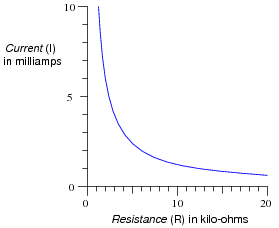
Notes:Ask your students to explain how they plotted the two functions. Did they make a table of values first? Did they draw dots on the paper and then connect those dots with a line? Did anyone plot dots for the endpoints and then draw a straight line in between because they knew this was a linear function?
Many students are surprised that the plot is nonlinear, being that resistors are considered linear devices!
-
Question 3 of 16
Observe the following equivalence:
43 ×42 = (4 ×4 ×4) ×(4 ×4) Since all operations are the same (multiplication) and reversible, the parentheses are not needed. Therefore, we may write the expression like this:
4 ×4 ×4 ×4 ×4 Of course, the simplest way to write this is 45, since there are five 4’s multiplied together.
Expand each of these expressions so that there are no exponents either:
- 35 ×32 =
- 104 ×103 =
- 82 ×83 =
- 201 ×202 =
After expanding each of these expressions, re-write each one in simplest form: one number to a power, just like the final form of the example given (45). From these examples, what pattern do you see with exponents of products. In other words, what is the general solution to the following expression?
am ×an = Reveal answeram ×an = am n Notes:I have found that students who cannot fathom the general rule (am × an = am+n) often understand for the first time when they see concrete examples.
Related Tools:
- Performance-Based Assessments for DC Circuit Competencies
- Conventional Transistor Overview and Special Transistors






Question 3, answer - the ‘+’ symbol is missing from ‘= a^(m+n)’.
Question 7, question and answer - second equation should have a multiplication symbol, not the ‘variable x’.
Question 8, question and answer - second equation should have a multiplication symbol, not the ‘variable x’.
Question 9, question - the ‘+’ symbol is missing between ‘4.5154 ‘+’ 14’.
Question 9, answer:
- the ‘+’ symbol is missing: 10 − 25 ×2 ‘+’ 5 = −35
- the ‘+’ symbol is missing: −8 ‘+’ 10^3 ×51 = 50992
- the ‘+’ symbol is missing: 12^4 ×(3 ‘+’ 11) = 290304
Question 9, question and answer: The square root should enclose the whole equation, and the equation should have a multiplication symbol, not the ‘variable x’.
Question 13, question and answer: The table columns need spacing and the ‘+’ symbol is missing from the headings ‘2x + 1’.
These are all correct in the PDF version.