Facebook
 Google
 GitHub
 Linkedin
Digital Circuits
Binary Math Circuits
11 questions By Tony R. Kuphaldt
-
Question 7 of 11
Compare the following two circuits, the first one being a digital adder and the second one being an analog summer:
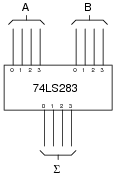

These two circuits perform the same mathematical function, yet the manners in which they perform this function are quite different. Compare and contrast the digital adder and the analog summer circuits shown here, citing any advantages or disadvantages of each.
Reveal answerI won’t directly give away answers here, but I will list a few criteria you might want to use for comparing and contrasting:
- Resolution
- Accuracy
- Speed
- Cost
Notes:This question is not really specific to adder/summer circuits, as it may first appear. The fundamental comparison being drawn in this question is between digital and analog. This is an important concept for students to grasp, as both have their roles in modern electronics. A common fallacy is that “digital is better” in all circumstances, but the truth is that both digital and analog have their respective strengths and limitations.
-
Question 8 of 11
Explain the purpose of a magnitude comparator IC such as the 74LS85. What function, or functions, does it perform?
Reveal answerI will let you research the datasheet for a magnitude comparator on your own to discover the answer(s)!
Notes:Be sure to ask students where they obtained their information. It is very easy to obtain datasheets online (over the internet), making it convenient to assign short research projects such as this.
-
Question 9 of 11
Research the datasheet of an integrated arithmetic logic unit such as the 74AS181, and determine how its various modes of operation (addition, subtraction, comparison) are selected.
Reveal answerThis is a small research project I leave up to you! Be sure to bring a copy of your IC datasheet to class for discussion!
Follow-up question: an interesting feature of the 74AS181 is that it provides “arithmetic” functions as well as “logic” functions. These two modes could also be referred to as “binary” and “boolean,” respectively. Explain what distinguishes these two operating modes from one another, and why they are classified differently.
Notes:Although the 74181 ALU is a somewhat dated IC (in fact, some versions are obsolete as of this writing - 2005), it stands as a simple example for students to learn from. A circuit such as this provides a good example of the power of integration, as opposed to constructing a similar logic function from individual gates (not to mention discrete transistors!).
The follow-up question brings up a point many students are confused on: the distinction between binary (numerical) and boolean (bitwise) operations. Binary is a place-weighted numeration system, used to symbolize real numbers using only two states per place. Boolean is a number system characterized by having only two possible values. Since both binary and boolean have something to do with two-valued quantities, many students believe the two to be interchangeable terms and concepts. However, they are not, and an investigation of the two operating modes of this ALU highlights the distinction.