
 Facebook
 Google
 GitHub
 Linkedin
Discrete Semiconductor Devices and Circuits
Bipolar Junction Transistor (BJT) theory
28 questions By Tony R. Kuphaldt
-
Question 7 of 28
Bipolar junction transistor (BJT) function is usually considered in terms of currents: a relatively small current through one of the transistor’s terminals exerts control over a much larger current. Draw the directions of all currents for these two transistors (one NPN and one PNP), clearly identifying which of the currents is doing the control, and which of the currents is being controlled:

Reveal answer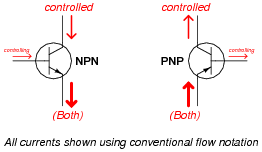
Notes:I have heard questions of this sort asked on technician job interviews. Knowing which way currents go through a BJT is considered a very fundamental aspect of electronics technician knowledge, and for good reason. It is impossible to understand the function of many transistor circuits without a firm grasp on which signal exerts control over which other signal in a circuit.
-
Question 8 of 28
The “beta” ratio (β) of a bipolar junction transistor, sometimes alternatively referred to as hFE, is a very important device parameter. In essence, it describes the amplifying power of the transistor. Give a mathematical definition for this parameter, and provide some typical values from transistor datasheets.
Reveal answerβ is defined as the ratio between collector and base current. I’ll let you research some typical values. Here are some transistor part numbers you could research datasheets for:
- 2N2222
- 2N2905
- 2N2907
- 2N3403
- 2N3703
- 2N3904
- 2N3906
- 2N4125
- 2N4403
- 2N3055
- TIP 29
- TIP 31
- TIP 32
- TIP 41
- TIP 42
Follow-up question #1: what conditions affect the β ratio of a transistor?
Follow-up question #2: re-write the β equation to solve for the other variables (IC = … , IB = …).
Notes:Ask your students to show you at least one datasheets for one of the listed transistors. With internet access, datasheets are extremely easy to locate. Your students will need to be able to locate component datasheets and application notes as part of their work responsibilities, so be sure they know how and where to access these valuable documents!
The follow-up question is an important one to discuss, as β is far from stable for most transistors! This point is often overlooked in basic electronics textbooks, leaving students with the false impression that transistor circuit calculations using β are far more accurate than they actually are.
-
Question 9 of 28
Find one or two real bipolar junction transistors and bring them with you to class for discussion. Identify as much information as you can about your transistors prior to discussion:
- Terminal identification (which terminal is base, emitter, collector)
- Continuous power rating
- Typical β
Reveal answerIf possible, find a manufacturer’s datasheet for your components (or at least a datasheet for a similar component) to discuss with your classmates. Be prepared to prove the terminal identifications of your transistors in class, by using a multimeter!
Notes:The purpose of this question is to get students to kinesthetically interact with the subject matter. It may seem silly to have students engage in a “show and tell” exercise, but I have found that activities such as this greatly help some students. For those learners who are kinesthetic in nature, it is a great help to actually touch real components while they’re learning about their function. Of course, this question also provides an excellent opportunity for them to practice interpreting component markings, use a multimeter, access datasheets, etc.




What surprises me is the following: I did not see any mentioning of the most important BJT parameter: Transconductance gm.
(Instead, you are stating that the beta-value would be a very important parameter - which is NOT the case!).
Like some other low-level electronic books and papers you treat the BJT as a cittent-controlled device - this is simply wrong.
There is not a single proof that the BJT would be a CCCS !
However, there are many theoretical explanations, measurements and observable facts which clearly show that the BJT is - of course - voltage-controlled. Who can deny it ? With which arguments? Ic=beta x Ib is just a formula - a misinterpretation of Ib=Ic/beta.