
 Facebook
 Google
 GitHub
 Linkedin
Discrete Semiconductor Devices and Circuits
Bipolar Junction Transistor (BJT) theory
28 questions By Tony R. Kuphaldt
-
Question 4 of 28
A bipolar junction transistor parameter similar to β is “alpha,” symbolized by the Greek letter α. It is defined as the ratio between collector current and emitter current:
$$\alpha = \frac{I_C}{I_E}$$
Apply algebraic substitution to this formula so that alpha is defined as a function of beta: \(\alpha=f(\beta)\). In other words, substitute and manipulate this equation until you have alpha by itself on one side and no variable except beta on the other.
You may find the following equations helpful in your work:
$$\beta=\frac{I_C}{I_B} \ \ \ \ \ \ \ \ \ \ \ \ I_E=I_C+I_B$$
Reveal answer$$\alpha=\frac{\beta}{\beta+1}$$
Follow-up question: what range of values might you expect for α, with a typical transistor?
Notes:This question is nothing more than an exercise in algebraic manipulation.
-
Question 5 of 28
A technician uses a multimeter’s “diode check” function to identify the terminals on a BJT. There are only two places where a non-infinite reading is obtained, and they are as follows:
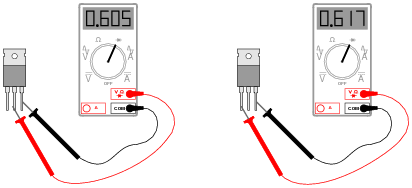
From these measurements, determine what type of BJT this is (PNP or NPN) and identify all three terminals.
Reveal answer
Notes:It is a very useful skill to be able to identify a BJT using nothing more than the “diode check” function on a multimeter.
-
Question 6 of 28
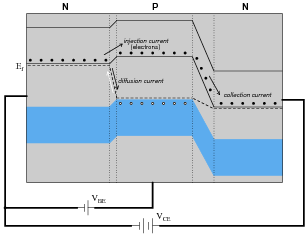
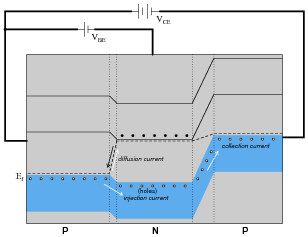
Conduction of an electric current through the collector terminal of a bipolar junction transistor requires that minority carriers be “injected” into the base region by a base-emitter current. Only after being injected into the base region may these charge carriers be swept toward the collector by the applied voltage between emitter and collector to constitute a collector current:
An analogy to help illustrate this is a person tossing flower petals into the air above their head, while a breeze carries the petals horizontally away from them. None of the flower petals may be ßwept” away by the breeze until the person releases them into the air, and the velocity of the breeze has no bearing on how many flower petals are swept away from the person, since they must be released from the person’s grip before they can go anywhere.
By referencing either the energy diagram or the flower petal analogy, explain why the collector current for a BJT is strongly influenced by the base current and only weakly influenced by the collector-to-emitter voltage.
Reveal answerThe action of tossing flower petals into the air is analogous to base current injecting charge carriers into the base region of a transistor. The drifting of those tossed petals by the wind is analogous to the sweeping of charge carriers across the base and into the collector by VCE. Like the number of flower petals drifting, the amount of collector current does not depend much on the strength of VCE (the strength of the wind), but rather on the rate of charge carriers injected (the number of petals tossed upward per second).
Notes:This is one of my better analogies for explaining BJT operation, especially for illustrating the why IC is almost independent of VCE. It also helps to explain reverse recovery time for transistors: imagine how long it takes the air to clear of tossed flower petals after you stop tossing them, analogous to latent charge carriers having to be swept out of the base region by VCE after base current stops.



What surprises me is the following: I did not see any mentioning of the most important BJT parameter: Transconductance gm.
(Instead, you are stating that the beta-value would be a very important parameter - which is NOT the case!).
Like some other low-level electronic books and papers you treat the BJT as a cittent-controlled device - this is simply wrong.
There is not a single proof that the BJT would be a CCCS !
However, there are many theoretical explanations, measurements and observable facts which clearly show that the BJT is - of course - voltage-controlled. Who can deny it ? With which arguments? Ic=beta x Ib is just a formula - a misinterpretation of Ib=Ic/beta.