Facebook
 Google
 GitHub
 Linkedin
Mathematics for Electronics
Calculus for Electric Circuits
30 questions By Tony R. Kuphaldt
-
Question 19 of 30
∫f(x) dx Calculus alert!
A Rogowski coil has a mutual inductance rating of 5 μH. Calculate the size of the resistor necessary in the integrator circuit to give the integrator output a 1:1 scaling with the measured current, given a capacitor size of 4.7 nF:
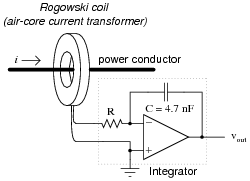
That is, size the resistor such that a current through the conductor changing at a rate of 1 amp per second will generate an integrator output voltage changing at a rate of 1 volt per second.
Reveal answerR = 1.064 kΩ
Notes:This question not only tests students’ comprehension of the Rogowski coil and its associated calculus (differentiating the power conductor current, as well as the need to integrate its output voltage signal), but it also tests students’ quantitative comprehension of integrator circuit operation and problem-solving technique. Besides, it gives some practical context to integrator circuits!
-
Question 20 of 30
∫f(x) dx Calculus alert!
The chain rule of calculus states that:
dx dydy dz= dx dzSimilarly, the following mathematical principle is also true:
dx dy= dx dzdy dzIt is very easy to build an opamp circuit that differentiates a voltage signal with respect to time, such that an input of x produces an output of [dx/dt], but there is no simple circuit that will output the differential of one input signal with respect to a second input signal.
However, this does not mean that the task is impossible. Draw a block diagram for a circuit that calculates [dy/dx], given the input voltages x and y. Hint: this circuit will make use of differentiators.
Challenge question: draw a full opamp circuit to perform this function!
Reveal answer
Notes:Differentiator circuits are very useful devices for making “live” calculations of time-derivatives for variables represented in voltage form. Explain to your students, for example, that the physical measurement of velocity, when differentiated with respect to time, is acceleration. Thus, a differentiator circuit connected to a tachogenerator measuring the speed of something provides a voltage output representing acceleration.
Being able to differentiate one signal in terms of another, although equally useful in physics, is not so easy to accomplish with opamps. A question such as this one highlights a practical use of calculus (the “chain rule”), where the differentiator circuit’s natural function is exploited to achieve a more advanced function.
-
Question 21 of 30
∫f(x) dx Calculus alert!
Ohm’s Law tells us that the amount of voltage dropped by a fixed resistance may be calculated as such:
E = IR However, the relationship between voltage and current for a fixed inductance is quite different. The “Ohm’s Law” formula for an inductor is as such:
e = L di dtWhat significance is there in the use of lower-case variables for current (i) and voltage (e)? Also, what does the expression [di/dt] mean? Note: in case you think that the d’s are variables, and should cancel out in this fraction, think again: this is no ordinary quotient! The d letters represent a calculus concept known as a differential, and a quotient of two d terms is called a derivative.
Reveal answerLower-case variables represent instantaneous values, as opposed to average values. The expression [di/dt] represents the instantaneous rate of change of current over time.
Follow-up question: manipulate this equation to solve for the other two variables ([di/dt] = … ; L = …).
Notes:I have found that the topics of capacitance and inductance are excellent contexts in which to introduce fundamental principles of calculus to students. The time you spend discussing this question and questions like it will vary according to your students’ mathematical abilities.
Even if your students are not ready to explore calculus, it is still a good idea to discuss how the relationship between current and voltage for an inductance involves time. This is a radical departure from the time-independent nature of resistors, and of Ohm’s Law!