Facebook
 Google
 GitHub
 Linkedin
Mathematics for Electronics
Calculus for Electric Circuits
30 questions By Tony R. Kuphaldt
-
Question 22 of 30
∫f(x) dx Calculus alert!
Digital logic circuits, which comprise the inner workings of computers, are essentially nothing more than arrays of switches made from semiconductor components called transistors. As switches, these circuits have but two states: on and off, which represent the binary states of 1 and 0, respectively.
The faster these switch circuits are able to change state, the faster the computer can perform arithmetic and do all the other tasks computers do. To this end, computer engineers keep pushing the limits of transistor circuit design to achieve faster and faster switching rates.
This race for speed causes problems for the power supply circuitry of computers, though, because of the current “surges” (technically called transients) created in the conductors carrying power from the supply to the logic circuits. The faster these logic circuits change state, the greater the [di/dt] rates-of-change exist in the conductors carrying current to power them. Significant voltage drops can occur along the length of these conductors due to their parasitic inductance:

Suppose a logic gate circuit creates transient currents of 175 amps per nanosecond (175 A/ns) when switching from the “off” state to the “on” state. If the total inductance of the power supply conductors is 10 picohenrys (9.5 pH), and the power supply voltage is 5 volts DC, how much voltage remains at the power terminals of the logic gate during one of these “surges”?
Reveal answerVoltage remaining at logic gate terminals during current transient = 3.338 V
Notes:Students will likely marvel at the [di/dt] rate of 175 amps per nanosecond, which equates to 175 billion amps per second. Not only is this figure realistic, though, it is also low by some estimates (see IEEE Spectrum
magazine, July 2003, Volume 40, Number 7, in the article “Putting Passives In Their Place”). Some of your students may be very skeptical of this figure, not willing to believe that ä computer power supply is capable of outputting 175 billion amps?!”
This last statement represents a very common error students commit, and it is based on a fundamental misunderstanding of [di/dt]. “175 billion amps per second” is not the same thing as “175 billion amps”. The latter is an absolute measure, while the former is a rate of change over time. It is the difference between saying “1500 miles per hour” and “1500 miles”. Just because a bullet travels at 1500 miles per hour does not mean it will travel 1500 miles! And just because a power supply is incapable of outputting 175 billion amps does not mean it cannot output a current that changes at a rate of 175 billion amps per second!
-
Question 23 of 30
∫f(x) dx Calculus alert!
Inductors store energy in the form of a magnetic field. We may calculate the energy stored in an inductance by integrating the product of inductor voltage and inductor current (P = IV) over time, since we know that power is the rate at which work (W) is done, and the amount of work done to an inductor taking it from zero current to some non-zero amount of current constitutes energy stored (U):
P = dW dtdW = P dt U = W = ⌠ ⌡ P dt Find a way to substitute inductance (L) and current (I) into the integrand so you may integrate to find an equation describing the amount of energy stored in an inductor for any given inductance and current values.
Reveal answerU = 1 2LI2 Notes:The integration required to obtain the answer is commonly found in calculus-based physics textbooks, and is an easy (power rule) integration.
-
Question 24 of 30
∫f(x) dx Calculus alert!
Define what “derivative” means when applied to the graph of a function. For instance, examine this graph:
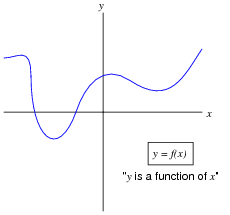
Label all the points where the derivative of the function ([dy/dx]) is positive, where it is negative, and where it is equal to zero.
Reveal answerThe graphical interpretation of “derivative” means the slope of the function at any given point.

Notes:Usually students find the concept of the derivative easiest to understand in graphical form: being the slope of the graph. This is true whether or not the independent variable is time (an important point given that most “intuitive” examples of the derivative are time-based!).