Facebook
 Google
 GitHub
 Linkedin
Mathematics for Electronics
Calculus for Electric Circuits
30 questions By Tony R. Kuphaldt
-
Question 25 of 30
∫f(x) dx Calculus alert!
Shown here is the graph for the function y = x2:
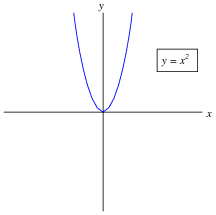
Sketch an approximate plot for the derivative of this function.
Reveal answer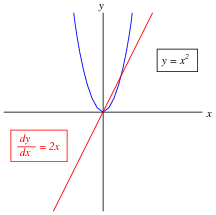
Challenge question: derivatives of power functions are easy to determine if you know the procedure. In this case, the derivative of the function y = x2 is [dy/dx] = 2x. Examine the following functions and their derivatives to see if you can recognize the “rule” we follow:
- y = x3 [dy/dx] = 3x2
- y = x4 [dy/dx] = 4x3
- y = 2x4 [dy/dx] = 8x3
- y = 10x5 [dy/dx] = 50x4
- y = 2x3 5x2 − 7x [dy/dx] = 6x2 10x − 7
- y = 5x3 − 2x − 16 [dy/dx] = 15x2 − 2
- y = 4x7 − 6x3 9x 1 [dy/dx] = 28x6 − 18x2 9
Notes:Usually students find the concept of the derivative easiest to understand in graphical form: being the slope of the graph. This is true whether or not the independent variable is time (an important point given that most “intuitive” examples of the derivative are time-based!).
Even if your students are not yet familiar with the power rule for calculating derivatives, they should be able to tell that [dy/dx] is zero when x = 0, positive when x > 0, and negative when x < 0.
-
Question 26 of 30
∫f(x) dx Calculus alert!
Calculus is widely (and falsely!) believed to be too complicated for the average person to understand. Yet, anyone who has ever driven a car has an intuitive grasp of calculus’ most basic concepts: differentiation and integration. These two complementary operations may be seen at work on the instrument panel of every automobile:
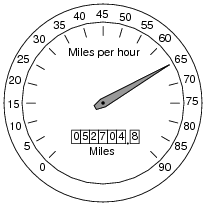
On this one instrument, two measurements are given: speed in miles per hour, and distance traveled in miles. In areas where metric units are used, the units would be kilometers per hour and kilometers, respectively. Regardless of units, the two variables of speed and distance are related to each other over time by the calculus operations of integration and differentiation. My question for you is which operation goes which way?
We know that speed is the rate of change of distance over time. This much is apparent simply by examining the units (miles per hour indicates a rate of change over time). Of these two variables, speed and distance, which is the derivative of the other, and which is the integral of the other? Also, determine what happens to the value of each one as the other maintains a constant (non-zero) value.
Reveal answerSpeed is the derivative of distance; distance is the integral of speed.
If the speed holds steady at some non-zero value, the distance will accumulate at a steady rate. If the distance holds steady, the speed indication will be zero because the car is at rest.
Notes:The goal of this question is to get students thinking in terms of derivative and integral every time they look at their car’s speedometer/odometer, and ultimately to grasp the nature of these two calculus operations in terms they are already familiar with.
-
Question 27 of 30
∫f(x) dx Calculus alert!
Define what “integral” means when applied to the graph of a function. For instance, examine this graph:
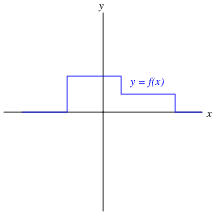
Sketch an approximate plot for the integral of this function.
Reveal answerThe graphical interpretation of “integral” means the area accumulated underneath the function for a given domain.

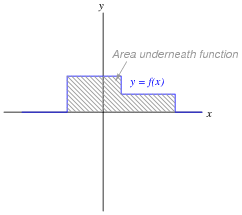
Notes:Usually students find the concept of the integral a bit harder to grasp than the concept of the derivative, even when interpreted in graphical form. One way to help them make this “leap” is to remind them that integration and differentiation are inverse functions, then ask them to analyze the answer “backwards” (looking at the red integral plot and seeing how the blue function is the derivative of the red function). The thought process is analogous to explaining logarithms to students for the very first time: when we take the logarithm of a number, we are figuring out what power we would have to raise the base to get that number (e.g. log1000 = 3 ; 103 = 1000). When we determine the integral of a function, we are figuring out what other function, when differentiated, would result in the given function. This is the essence of what we mean by inverse functions, and it is an important concept in algebra, trigonometry, and calculus alike.