Facebook
 Google
 GitHub
 Linkedin
Mathematics for Electronics
Calculus for Electric Circuits
30 questions By Tony R. Kuphaldt
-
Question 28 of 30
∫f(x) dx Calculus alert!
A forward-biased PN semiconductor junction does not possess a “resistance” in the same manner as a resistor or a length of wire. Any attempt at applying Ohm’s Law to a diode, then, is doomed from the start.
This is not to say that we cannot assign a dynamic value of resistance to a PN junction, though. The fundamental definition of resistance comes from Ohm’s Law, and it is expressed in derivative form as such:
R = dV dIThe fundamental equation relating current and voltage together for a PN junction is Shockley’s diode equation:
I = IS (e[qV/NkT] − 1) At room temperature (approximately 21 degrees C, or 294 degrees K), the thermal voltage of a PN junction is about 25 millivolts. Substituting 1 for the non-ideality coefficient, we may simply the diode equation as such:
I = IS (e[V/0.025] − 1) or I = IS (e40 V − 1) Differentiate this equation with respect to V, so as to determine [dI/dV], and then reciprocate to find a mathematical definition for dynamic resistance ([dV/dI]) of a PN junction. Hints: saturation current (IS) is a very small constant for most diodes, and the final equation should express dynamic resistance in terms of thermal voltage (25 mV) and diode current (I).
Reveal answerr ≈ 25 mV INotes:The result of this derivation is important in the analysis of certain transistor amplifiers, where the dynamic resistance of the base-emitter PN junction is significant to bias and gain approximations. I show the solution steps for you here because it is a neat application of differentiation (and substitution) to solve a real-world problem:
I = IS (e40 V − 1) dI dV= IS (40e40 V − 0) dI dV= 40 IS e40 V Now, we manipulate the original equation to obtain a definition for IS e40 V in terms of current, for the sake of substitution:
I = IS (e40 V − 1) I = IS e40 V − IS I IS = IS e40 V Substituting this expression into the derivative:
dI dV= 40 (I IS) Reciprocating to get voltage over current (the proper form for resistance):
dV dI= 0.025 I ISNow we may get rid of the saturation current term, because it is negligibly small:
dV dI≈ 0.025 Ir ≈ 25 mV IThe constant of 25 millivolts is not set in stone, by any means. Its value varies with temperature, and is sometimes given as 26 millivolts or even 30 millivolts.
-
Question 29 of 30
∫f(x) dx Calculus alert!
Just as addition is the inverse operation of subtraction, and multiplication is the inverse operation of division, a calculus concept known as integration is the inverse function of differentiation. Symbolically, integration is represented by a long “S”-shaped symbol called the integrand:
If x = dy dt( x is the derivative of y with respect to t) Then y = ⌠ ⌡ x dt ( y is the integral of x with respect to t) To be truthful, there is a bit more to this reciprocal relationship than what is shown above, but the basic idea you need to grasp is that integration “un-does” differentiation, and visa-versa. Derivatives are a bit easier for most people to understand, so these are generally presented before integrals in calculus courses. One common application of derivatives is in the relationship between position, velocity, and acceleration of a moving object. Velocity is nothing more than rate-of-change of position over time, and acceleration is nothing more than rate-of-change of velocity over time:
v = dx dtVelocity (v ) is the time−derivative of position (x ) a = dv dtAcceleration (a ) is the time−derivative of velocity (v ) Illustrating this in such a way that shows differentiation as a process:

Given that you know integration is the inverse-function of differentiation, show how position, velocity, and acceleration are related by integration. Show this both in symbolic (proper mathematical) form as well as in an illustration similar to that shown above.
Footnotes:
It is perfectly accurate to say that differentiation undoes integration, so that [d/dt] ∫x dt = x, but to say that integration undoes differentiation is not entirely true because indefinite integration always leaves a constant C that may very well be non-zero, so that ∫[dx/dt] dt = x C rather than simply being x.
Reveal answerx = ⌠ ⌡ v dt Position (x ) is the time−integral of velocity (v ) v = ⌠ ⌡ a dt Velocity (v ) is the time−integral of acceleration (a ) 
Challenge question: explain why the following equations are more accurate than those shown in the answer.
x = ⌠ ⌡ v dt x0 Position (x ) is the time−integral of velocity (v ) v = ⌠ ⌡ a dt v0 Velocity (v ) is the time−integral of acceleration (a ) Where,
x0 is the initial position (at time = 0)
v0 is the initial velocity (at time = 0)
Notes:The purpose of this question is to introduce the integral as an inverse-operation to the derivative. Introducing the integral in this manner (rather than in its historical origin as an accumulation of parts) builds on what students already know about derivatives, and prepares them to see integrator circuits as counterparts to differentiator circuits rather than as unrelated entities.
-
Question 30 of 30
∫f(x) dx Calculus alert!
Calculus is a branch of mathematics that originated with scientific questions concerning rates of change. The easiest rates of change for most people to understand are those dealing with time. For example, a student watching their savings account dwindle over time as they pay for tuition and other expenses is very concerned with rates of change (dollars per day being spent).
The “derivative” is how rates of change are symbolically expressed in mathematical equations. For example, if the variable S represents the amount of money in the student’s savings account and t represents time, the rate of change of dollars over time (the time-derivative of the student’s account balance) would be written as [dS/dt]. The process of calculating this rate of change from a record of the account balance over time, or from an equation describing the balance over time, is called differentiation.
Suppose, though, that instead of the bank providing the student with a statement every month showing the account balance on different dates, the bank were to provide the student with a statement every month showing the rates of change of the balance over time, in dollars per day, calculated at the end of each day:
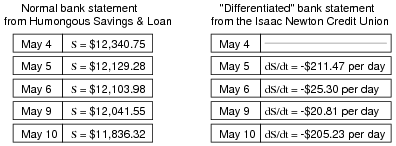
Explain how the Isaac Newton Credit Union calculates the derivative ([dS/dt]) from the regular account balance numbers (S in the Humongous Savings & Loan statement), and then explain how the student who banks at Isaac Newton Credit Union could figure out how much money is in their account at any given time.
Hint: the process of calculating a variable’s value from rates of change is called integration in calculus. It is the opposite (inverse) function of differentiation.
Reveal answerThe Isaac Newton Credit Union differentiates S by dividing the difference between consecutive balances by the number of days between those balance figures. Differentiation is fundamentally a process of division.
To integrate the [dS/dt] values shown on the Credit Union’s statement so as to arrive at values for S, we must either repeatedly add or subtract the days’ rate-of-change figures, beginning with a starting balance. Thus, integration is fundamentally a process of multiplication.
Follow-up question: explain why a starting balance is absolutely necessary for the student banking at Isaac Newton Credit Union to know in order for them to determine their account balance at any time. Why would it be impossible for them to figure out how much money was in their account if the only information they possessed was the [dS/dt] figures?
Notes:The purpose of this question is to introduce the concept of the integral to students in a way that is familiar to them. Hopefully the opening scenario of a dwindling savings account is something they can relate to!
Some students may ask why the differential notation [dS/dt] is used rather than the difference notation [(∆S)/(∆t)] in this example, since the rates of change are always calculated by subtraction of two data points (thus implying a ∆). Given that the function here is piecewise and not continuous, one could argue that it is not differentiable at the points of interest. My purpose in using differential notation is to familiarize students with the concept of the derivative in the context of something they can easily relate to, even if the particular details of the application suggest a more correct notation.