Facebook
 Google
 GitHub
 Linkedin
AC Electric Circuits
Capacitive Reactance
15 questions By Tony R. Kuphaldt
-
Question 10 of 15
Explain all the steps necessary to calculate the amount of current in this capacitive AC circuit:
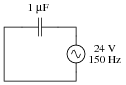
Reveal answerI = 22.6 mA
Notes:The current is not difficult to calculate, so obviously the most important aspect of this question is not the math. Rather, it is the procedure of calculation: what to do first, second, third, etc., in obtaining the final answer.
-
Question 11 of 15
In DC circuits, we have Ohm’s Law to relate voltage, current, and resistance together:
E = I R In AC circuits, we similarly need a formula to relate voltage, current, and impedance together. Write three equations, one solving for each of these three variables: a set of Ohm’s Law formulae for AC circuits. Be prepared to show how you may use algebra to manipulate one of these equations into the other two forms.
Reveal answerE = I Z I = E ZZ = E IIf using phasor quantities (complex numbers) for voltage, current, and impedance, the proper way to write these equations is as follows:
E = IZ I = E ZZ = E IBold-faced type is a common way of denoting vector quantities in mathematics.
Notes:Although the use of phasor quantities for voltage, current, and impedance in the AC form of Ohm’s Law yields certain distinct advantages over scalar calculations, this does not mean one cannot use scalar quantities. Often it is appropriate to express an AC voltage, current, or impedance as a simple scalar number.
-
Question 12 of 15
It is often necessary to represent AC circuit quantities as complex numbers rather than as scalar numbers, because both magnitude and phase angle are necessary to consider in certain calculations.
When representing AC voltages and currents in polar form, the angle given refers to the phase shift between the given voltage or current, and a “reference” voltage or current at the same frequency somewhere else in the circuit. So, a voltage of 3.5 V ∠−45o means a voltage of 3.5 volts magnitude, phase-shifted 45 degrees behind (lagging) the reference voltage (or current), which is defined to be at an angle of 0 degrees.
But what about impedance (Z)? Does impedance have a phase angle, too, or is it a simple scalar number like resistance or reactance?
Calculate the amount of current that would go “through” a 0.1 μF capacitor with 48 volts RMS applied to it at a frequency of 100 Hz. Then, based on Ohm’s Law for AC circuits and what you know of the phase relationship between voltage and current for a capacitor, calculate the impedance of this capacitor in polar form. Does a definite angle emerge from this calculation for the capacitor’s impedance? Explain why or why not.
Reveal answerZC = 15.92 kΩ ∠ -90o
Notes:This is a challenging question, because it asks the student to defend the application of phase angles to a type of quantity that does not really possess a wave-shape like AC voltages and currents do. Conceptually, this is difficult to grasp. However, the answer is quite clear through the Ohm’s Law calculation (Z = E/I).
Although it is natural to assign a phase angle of 0o to the 48 volt supply, making it the reference waveform, this is not actually necessary. Work through this calculation with your students, assuming different angles for the voltage in each instance. You should find that the impedance computes to be the same exact quantity every time.