Facebook
 Google
 GitHub
 Linkedin
AC Electric Circuits
Capacitive Reactance
15 questions By Tony R. Kuphaldt
-
Question 13 of 15
Explain how you could calculate the capacitance value of a capacitor (in units of Farads), by measuring AC voltage, AC current, and frequency in a circuit of this configuration:
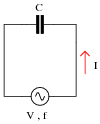
Write a single formula solving for capacitance given these three values (V, I, and f).
Reveal answerC = I 2 πf VNotes:Ask your students to show how they arrived at the formula for calculating C. The algebra is not difficult, but some substitution is required.
-
Question 14 of 15
A technician measures voltage across the terminals of a burned-out solenoid valve, in order to check for the presence of dangerous voltage before touching the wire connections. The circuit breaker for this solenoid has been turned off and secured with a lock, but the technician’s digital voltmeter still registers about three and a half volts AC across the solenoid terminals!
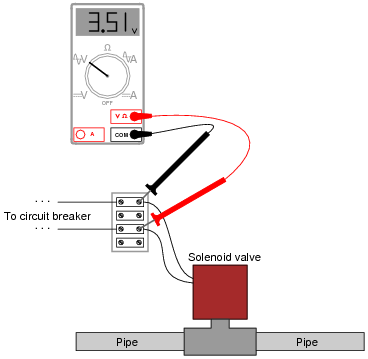
Now, three and a half volts AC is not enough voltage to cause any harm, but its presence confuses and worries the technician. Shouldn’t there be 0 volts, with the breaker turned off?
Explain why the technician is able to measure voltage in a circuit that has been “locked out.” Hint: digital voltmeters have extremely high input impedance, typically in excess of 10 MΩ.
Reveal answerThe stray capacitance existing between the open contacts of the breaker provides a high-impedance path for AC voltage to reach the voltmeter test leads.
Follow-up question: while the measured voltage in this case was well below the general industry threshold for shock hazard (30 volts), a slightly different scenario could have resulted in a much greater “phantom” voltage measurement. Could a capacitively-coupled voltage of this sort possibly pose a safety hazard? Why or why not?
Challenge question: is it possible for the technician to discern whether or not the 3.51 volts measured by the voltmeter is “real”? In other words, what if this small voltage is not the result of stray capacitance across the breaker contacts, but rather some other source of AC capable of delivering substantial current? How can the technician determine whether or not the 3.51 volts is capable of sourcing significant amounts of current?
Notes:I cannot tell you how many times I encountered this phenomenon: “phantom” AC voltages registered by high-impedance DMM’s in circuits that are supposed to be “dead.” Industrial electricians often use a different instrument to check for the presence of dangerous voltage, a crude device commonly known as a “Wiggy.”
-
Question 15 of 15
Audio headphones make highly sensitive voltage detectors for AC signals in the audio frequency range. However, the small speakers inside headphones are quite easily damaged by the application of DC voltage.
Explain how a capacitor could be used as a “filtering” device to allow AC signals through to a pair of headphones, yet block any applied DC voltage, so as to help prevent accidental damage of the headphones while using them as an electrical instrument.
The key to understanding how to answer this question is to recognize what a capacitor “appears as” to AC signals versus DC signals.
Reveal answerConnect a capacitor in series with the headphone speakers.
Notes:I highly recommend to students that they should build a transformer-isolation circuit if they intend to use a pair of audio headphones as a test device (see question file number 00983 for a complete schematic diagram).