Facebook
 Google
 GitHub
 Linkedin
Digital Circuits
Performance-Based Assessments for Digital Circuit Competencies
43 questions By Tony R. Kuphaldt
-
Question 1 of 43
(Template) 
Reveal answerHere, you would indicate where or how to obtain answers for the requested parameters, but not actually give the figures. My stock answer here is “use circuit simulation software” (Spice, Multisim, etc.).
Notes:Any relevant notes for the assessment activity go here.
-
Question 2 of 43
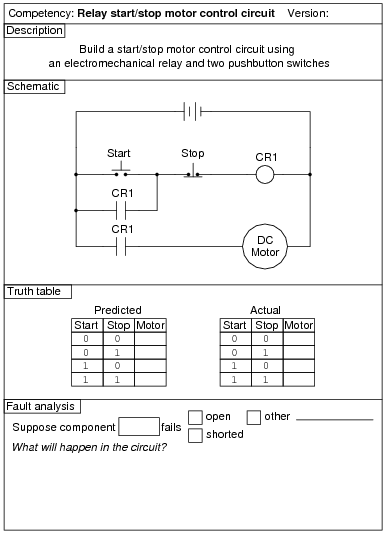
Reveal answerThe real circuit you build will validate your circuit design.
Notes:An extension of this exercise is to incorporate troubleshooting questions. Whether using this exercise as a performance assessment or simply as a concept-building lab, you might want to follow up your students’ results by asking them to predict the consequences of certain circuit faults.
-
Question 3 of 43
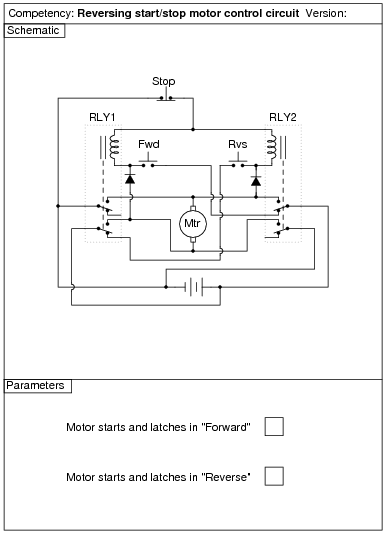
Reveal answerThe real circuit you build will validate your circuit design.
Notes:An extension of this exercise is to incorporate troubleshooting questions. Whether using this exercise as a performance assessment or simply as a concept-building lab, you might want to follow up your students’ results by asking them to predict the consequences of certain circuit faults.
The two diodes in this circuit are a matter of necessity: getting the circuit to work with only two sets of switch contacts per relay. Ideally, each relay would be 3PDT with separate contact sets for latching, interlocking, and motor power. To use a DPDT relay requires that one of these contact sets do double-duty. In this case, one of the contact sets on each relay handling power to the motor must also handle the job of seal-in (latching). Without the diodes in place, both relays chatter when either motion button is pressed. This is because both relay coils receive power: one coil directly through the switch; the other through the same switch, back through the motor, and then through the seal-in (latching) connection. The diodes prevent this “feed-through” to the other relay coil from happening, without interfering with the normal latching function.