Facebook
 Google
 GitHub
 Linkedin
AC Electric Circuits
Characteristic Impedance
17 questions By Tony R. Kuphaldt
-
Question 16 of 17
Some communications networks use cables to not only provide a path for data transmission, but also DC power to energize the circuits connected to the cable.
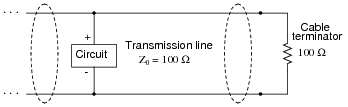
However, if we were to terminate the cable as shown, the termination resistor would dissipate a substantial amount of power. This is wasted energy, and would unnecessarily burden the power supply providing DC power to the network cable.
How can we eliminate the problem of power dissipated by the termination resistor in a DC power/signal cable and yet still maintain proper termination to avoid reflected signals?
Reveal answerA capacitor must be connected in series with the termination resistance to prevent the resistance from acting as a DC load on the network:

Notes:Understanding this answer requires that students recall the filtering behavior of a series capacitor in an AC circuit.
-
Question 17 of 17
Find a length of coaxial cable and bring it with you to class for discussion. Identify as much information as you can about your piece of cable prior to discussion:
- Characteristic impedance
- Insulation service (cable tray, conduit, direct burial, etc.)
- Type (RG-58, RG-6, etc.)
Reveal answerIf possible, find a manufacturer’s datasheet for your components (or at least a datasheet for a similar component) to discuss with your classmates.
Notes:The purpose of this question is to get students to kinesthetically interact with the subject matter. It may seem silly to have students engage in a “show and tell” exercise, but I have found that activities such as this greatly help some students. For those learners who are kinesthetic in nature, it is a great help to actually touch real components while they’re learning about their function. Of course, this question also provides an excellent opportunity for them to practice interpreting component markings, use a multimeter, access datasheets, etc.