Facebook
 Google
 GitHub
 Linkedin
DC Electric Circuits
DC Metrology
11 questions By Tony R. Kuphaldt
-
Question 7 of 11
The following voltmeter circuit avoids problems of “loading” when measuring high-resistance voltage sources. Describe how to operate this circuit, and how loading error is eliminated by using such a potentiometric instrument:
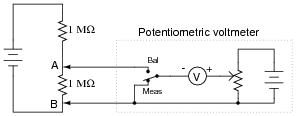
Reveal answerMove the switch to the “Bal” position and adjust the potentiometer until the meter movement registers zero volts precisely. Then, move the switch to the “Meas” position and read the voltage directly from the meter movement.
Notes:“Potentiometric” DC voltage measurements used to be commonplace in industry prior to the advent of precision electronic voltmeters with high-resistance inputs. The technique, though, is certainly not obsolete, and in fact is still employed in metrological laboratories worldwide to obtain the most accurate (no-load) voltage measurements possible.
It is impressive to have students build a potentiometric voltmeter circuit using a cheap analog VOM (Volt-Ohm-Milliammeter), and have it outperform a direct-reading, laboratory-quality digital voltmeter costing hundreds of dollars! The greater the resistance inherent to the voltage source being measured, the more severe the loading error of any voltmeter, and the more a potentiometric instrument proves its worth.
-
Question 8 of 11
General metrology used to be based upon standard artifacts, but the modern scientific trend is toward intrinsic standards. Explain what these two terms mean, as well as their significance in scientific work.
Reveal answerAn “artifact” is a non-reproduceable object that is arbitrarily deemed the “standard.” An “intrinsic” standard, by comparison, is a reproducible standard based on immutable physical constants.
Notes:A great example of an “artifact” standard is the metal bar which used to be the international standard for the “meter” (metric unit of length). Ask your students how convenient it would be for scientists working around the world to calibrate their equipment if the only primary standard for length measurement were a single bar of metal. What benefits may be derived from the use of “intrinsic” standards?
An excellent example of an easily-accessed intrinsic standard is the standard for time, available via shortwave radio: 5 kHz, 10kHz, 15 kHz, and 20 kHz (there are other frequencies, too). Have any of your students heard of timepieces that synchronize themselves to an “atomic clock”? With a shortwave radio, they can tune into that same atomic clock’s broadcast and synchronize their own wristwatches! This is an excellent discussion activity, and a great way to garner student interest in what is potentially a dull subject.
Ask your students whether or not the existence of intrinsic standards negates the purpose of artifacts. That is, does anyone use artifacts anymore? Why or why not?
-
Question 9 of 11
What technology is currently regarded as state-of-the-art for reproducing the standard volt?
Reveal answerThe voltage standard used to be based on a particular type of chemical battery, but not anymore!
Notes:Questions like this will never become obsolete, even though the answer may. At the time of this writing (August 2003), the internationally recognized technology for the standard volt is based on a quantum phenomenon known as the Josephson Junction effect.