Facebook
 Google
 GitHub
 Linkedin
AC Electric Circuits
Decibel Measurements
19 questions By Tony R. Kuphaldt
-
Question 4 of 19
Suppose an AC signal amplifier circuit has a voltage gain (ratio) of 2. That is, Vout is twice as large as Vin:
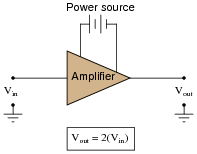
If we were to try to rate this amplifier’s gain in terms of the relative power dissipated by a given load resistance (Pload when powered by Vout, versus Pload when powered by Vin), what ratio would we calculate? In other words, what is the ratio of power for a given load resistance, when powered by a given voltage, versus when powered by a voltage that is twice as much?
Reveal answerPower ratio = 4:1
Notes:An easy way to illustrate this principle is to ask your students to calculate the power dissipation of a 1200 watt heating element rated for 120 volts, if connected to a 240 volt source. The answer is not 2400 watts!
-
Question 5 of 19
Suppose an AC signal amplifier circuit has a voltage gain (ratio) of 2. That is, Vout is twice as large as Vin:
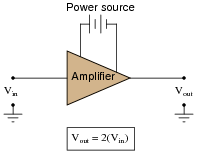
If we were to try to rate this amplifier’s gain in terms of the relative power dissipated by a given load resistance (Pload when powered by Vout, versus Pload when powered by Vin), what decibel figure would we calculate?
Reveal answerAP = 6.02 dB
Notes:An easy way to illustrate this principle is to ask your students to calculate the power dissipation of a 1200 watt heating element rated for 120 volts, if connected to a 240 volt source. The answer is not 2400 watts!
-
Question 6 of 19
Voltage and current gains, expressed in units of decibels, may be calculated as such:
AV(dB) = 10 log( AV(ratio) ) 2 AI(dB) = 10 log( AI(ratio) ) 2 Another way of writing this equation is like this:
AV(dB) = 20 logAV(ratio) AI(dB) = 20 logAI(ratio) What law of algebra allows us to simplify a logarithmic equation in this manner?
Reveal answerlogab = b loga Challenge question: knowing this algebraic law, solve for x in the following equation:
520 = 8x Notes:Logarithms are a confusing, but powerful, algebraic tool. In this example, we see how the logarithm of a power function is converted into a simple multiplication function.
The challenge question asks students to apply this relationship to an equation not containing logarithms at all. However, the fundamental rule of algebra is that you may perform any operation (including logarithms) to any equation so long as you apply it equally to both sides of the equation. Logarithms allow us to take an algebra problem such as this and simplify it significantly.