Facebook
 Google
 GitHub
 Linkedin
Basic Electricity
Elementary Circuits
12 questions By Tony R. Kuphaldt
-
Question 1 of 12
In the simplest terms you can think of, define what an electrical circuit is.
Reveal answerAn electrical circuit is any continuous path for electrons to flow away from a source of electrical potential (voltage) and back again.
Notes:Although definitions are easy enough to research and repeat, it is important that students learn to cast these concepts into their own words. Asking students to give practical examples of “circuits” and “non-circuits” is one way to ensure deeper investigation of the concepts than mere term memorization.
The word “circuit,” in vernacular usage, often refers to anything electrical. Of course, this is not true in the technical sense of the term. Students will come to realize that many terms they learn and use in an electricity or electronics course are actually mis-used in common speech. The word “short” is another example: technically it refers to a specific type of circuit fault. Commonly, though, people use it to refer to any type of electrical problem.
-
Question 2 of 12
Given a battery and a light bulb, show how you would connect these two devices together with wire so as to energize the light bulb:

Reveal answerThis is the simplest option, but not the only one.

Notes:This question gives students a good opportunity to discuss the basic concept of a circuit. It is very easy to build, safe, and should be assembled by each student individually in class. Also, emphasize how simple circuits like this may be assembled at home as part of the “research” portion of the worksheet. To research answers for worksheet questions does not necessarily mean the information has to come from a book! Encourage experimentation when the conditions are known to be safe.
Have students brainstorm all the important concepts learned in making this simple circuit. What general principles may be derived from this particular exercise?
-
Question 3 of 12
Draw an electrical schematic diagram of a circuit where a battery provides electrical energy to a light bulb.
Reveal answerThis schematic diagram is not the only valid way to show a battery powering a light bulb:
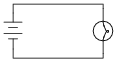
Other orientations of the components within the diagram are permissible. What matters, though, is for there to be a single, continuous path for electric current from the battery, to the light bulb, and back to the other terminal of the battery.
Notes:Impress upon the students the importance of learning to “communicate” in the language of schematic diagrams. The symbols and conventions learned here are international, and not limited to use in the United States.