Facebook
 Google
 GitHub
 Linkedin
DC Electric Circuits
Intermediate Electromagnetism and Electromagnetic Induction
24 questions By Tony R. Kuphaldt
-
Question 7 of 24
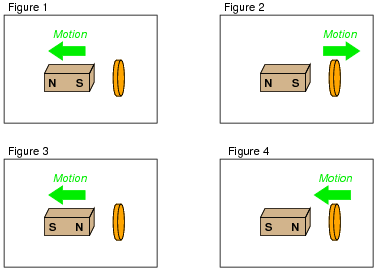
Lenz’s Law describes the opposition to changes in magnetic flux resulting from electromagnetic induction between a magnetic field and an electrical conductor. One apparatus capable of demonstrating Lenz’s Law is a copper or aluminum disk (electrically conductive, but non-magnetic) positioned close to the end of a powerful permanent magnet. There is no attraction or repulsion between the disk and magnet when there is no motion, but a force will develop between the two objects if either is suddenly moved. This force will be in such a direction that it tries to resist the motion (i.e. the force tries to maintain the gap constant between the two objects):

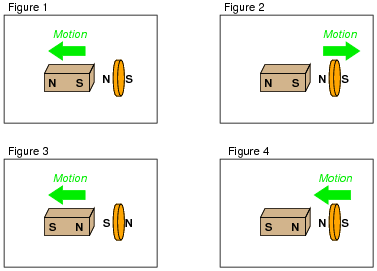
We know this force is magnetic in nature. That is, the induced current causes the disk itself to become a magnet in order to react against the permanent magnet’s field and produce the opposing force. For each of the following scenarios, label the disk’s induced magnetic poles (North and South) as it reacts to the motion imposed by an outside force:
Reveal answerThe disk’s own magnetic field will develop in such a way that it “fights” to keep a constant distance from the magnet:
Follow-up question: trace the direction of rotation for the induced electric current in the disk necessary to produce both the repulsive and the attractive force.
Notes:This phenomenon is difficult to demonstrate without a very powerful magnet. However, if you have such apparatus available in your lab area, it would make a great piece for demonstration!
One practical way I’ve demonstrated Lenz’s Law is to obtain a rare-earth magnet (very powerful!), set it pole-up on a table, then drop an aluminum coin (such as a Japanese Yen) so it lands on top of the magnet. If the magnet is strong enough and the coin is light enough, the coin will gently come to rest on the magnet rather than hit hard and bounce off.
A more dramatic illustration of Lenz’s Law is to take the same coin and spin it (on edge) on a table surface. Then, bring the magnet close to the edge of the spinning coin, and watch the coin promptly come to a halt, without contact between the coin and magnet.
Another illustration is to set the aluminum coin on a smooth table surface, then quickly move the magnet over the coin, parallel to the table surface. If the magnet is close enough, the coin will be “dragged” a short distance as the magnet passes over.
In all these demonstrations, it is significant to show to your students that the coin itself is not magnetic. It will not stick to the magnet as an iron or steel coin would, thus any force generated between the coin and magnet is strictly due to induced currents and not ferromagnetism.
-
Question 8 of 24
Combining Lenz’s Law with the right-hand rule (or left-hand rule, if you follow electron flow instead of conventional flow) provides a simple and effective means for determining the direction of induced current in an induction coil. In the following examples, trace the direction of current through the load resistor:
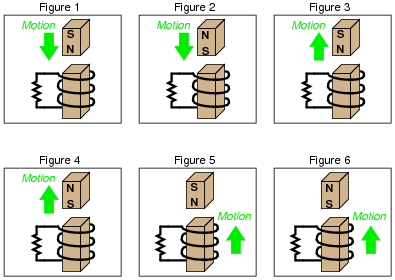
Reveal answerNote: in case it isn’t clear from the illustrations, Figures 1 through 4 show the magnet moving in relation to a stationary coil. Figures 5 and 6 show a coil moving in relation to a stationary magnet.

Notes:An easy way I find to remember Lenz’s Law is to interpret is as opposition to change. The coil will try to become a magnet that fights the motion. A good way to get students thinking along these lines is to ask them, “What magnetic polarity would the coil have to assume (in each case) to resist the magnet’s relative motion?” In other words, if the magnet moves closer to the coil, the coil will “magnetize” so as to push against the magnet. If the magnet moves away from the coil, the coil will “magnetize” so as to attract the magnet.
-
Question 9 of 24
Write the equation relating electric current and magnetic field strength together in a wire coil. If the current (I) is given in units of amperes, and the number of turns is a simple integer value, what unit of measurement will the magnetic field strength have?
Reveal answerF = IN Where,
F= Magnetomotive force (magnetic field strength), in amp-turns
I = Current in wire coil, amps
N = Number of turns in coil
Notes:Sometimes, units of measurement make perfect sense! In this case, the unit of the amp-turn follows obviously from the construction of the equation, with amps times turns.