Facebook
 Google
 GitHub
 Linkedin
DC Electric Circuits
Intermediate Electromagnetism and Electromagnetic Induction
24 questions By Tony R. Kuphaldt
-
Question 10 of 24
What is magnetic saturation?
Reveal answerMagnetic “saturation” is what happens when the magnetic flux (Φ, or flux density B) fails to increase in the same proportion to increases in magnetic field force (F, or field intensity H) that it did at lower levels of F
or H.
Notes:To use an economic phrase, saturation is a case of diminishing returns: where further increases in one variable yield smaller and smaller gains in another variable. It is important that students recognize the word “saturation” is used to describe phenomena other than magnetism, as well. But in any context it is used, the “diminishing returns” concept is the same.
-
Question 11 of 24
Explain what this graph means, and how it represents both saturation and hysteresis as magnetic phenomena:
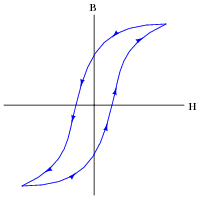
Reveal answerThis is a B-H curve, plotting the magnetic flux density (B) against the magnetic field intensity (H) of an electromagnet. The arrowheads represent the directions of increase and decrease in the variables.
“Saturation” is when B changes little for substantial changes in H. There are two regions on the B-H curve where saturation is evident.
Notes:This question is worthy of much discussion. It is one thing to recognize this curve as being a B−H curve, and quite another to explain exactly what it means. Ask your students to show on the curve, for instance, what happens when an electromagnet is fully energized with DC, and then the current is shut off, leaving a residual flux in the core. What is necessary to de-magnetize the core once again?
Also be sure to discuss saturation in detail. This is a very important magnetic phenomenon, without a direct analogy in electric circuits (it is not as though wires “saturate” when carrying too much current!).
-
Question 12 of 24
If an electric current is passed through this wire loop, in which position will it try to orient itself?
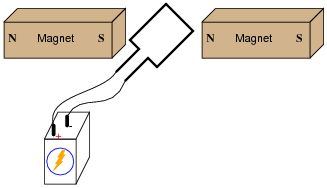
If this experiment is carried out, it may be found that the torque generated is quite small without resorting to high currents and/or strong magnetic fields. Devise a way to modify this apparatus so as to generate stronger torques using modest current levels and ordinary magnets.
Reveal answerThe loop will try to orient itself in a vertical plane, perpendicular to the axis of magnetic flux between the magnet poles:
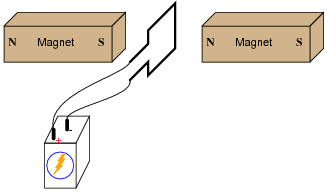
To increase the torque generated by the wire loop, you could use a loop with more than 1 “turn” of wire. This is not the only solution, though.
Notes:This question presents an excellent opportunity for discussing the “right-hand rule” (or “left-hand rule” for those using electron flow notation rather than conventional flow notation).