Facebook
 Google
 GitHub
 Linkedin
DC Electric Circuits
Intermediate Electromagnetism and Electromagnetic Induction
24 questions By Tony R. Kuphaldt
-
Question 13 of 24
By moving a permanent magnet perpendicularly past a wire, a voltage will be generated between the ends of that wire:
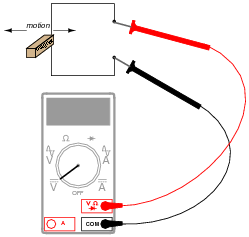
Describe what factors determine the polarity and magnitude of this voltage.
Reveal answerRather than give the answer here, I’ll leave it to you to determine the answer by experiment!
Notes:Experiments like this are so easy to set up, it would be a shame to spoil the joy of firsthand discovery by simply telling students what is supposed to happen!
-
Question 14 of 24
∫f(x) dx Calculus alert!
The relationship between magnetic flux and induced voltage in a wire coil is expressed in this equation, known as Faraday’s Law:e = N d φ dtWhere,
e = Instantaneous induced voltage, in volts
N = Number of turns in wire coil
φ = Instantaneous magnetic flux, in webers
t = Time, in seconds
Explain what the mathematical expression \(\frac{d φ}{dt}\) means, in light of what you know about electromagnetic induction. Hint: the \(\frac{d}{d}\) notation is borrowed from calculus, and it is called the derivative.
Also, explain why lower-case letters are used (e instead of E, φ instead of Φ) in this equation.
Reveal answerThe mathematical expression \(\frac{d φ}{dt}\)means “rate of change of magnetic flux over time.” In this particular example, the unit would be “webers per second.”
The use of lower-case letters for variables indicates instantaneous values: that is, quantities expressed in terms of instantaneous moments of time.
Follow-up question: manipulate this equation to solve for each variable (\(\frac{d φ}{dt}\) = … ; N = …).
Notes:For students who have never studied calculus, this is an excellent opportunity to introduce the concept of the derivative, having already established the principle of induced voltage being related to how quickly magnetic flux changes over time. In general physics studies, the quantities of position, velocity, and acceleration are similarly used to introduce the concept of the time-derivative, and later, the time-integral. In electricity, though, we have our own unique applications!
-
Question 15 of 24
How many turns of wire must a coil have in order to induce a voltage of 10.5 volts when exposed to a changing magnetic flux with a rate of 0.0075 Wb/s?
Reveal answer1400 turns
Notes:This is nothing but a quantitative application of Faraday’s Law, after algebraic manipulation to solve for N.