Facebook
 Google
 GitHub
 Linkedin
DC Electric Circuits
Intermediate Electromagnetism and Electromagnetic Induction
24 questions By Tony R. Kuphaldt
-
Question 16 of 24
If a copper ring is brought closer to the end of a permanent magnet, a repulsive force will develop between the magnet and the ring. This force will cease, however, when the ring stops moving. What is this effect called?
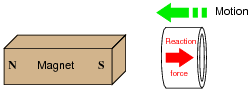
Also, describe what will happen if the copper ring is moved away from the end of the permanent magnet.
Reveal answerThe phenomenon is known as Lenz’ Law. If the copper ring is moved away from the end of the permanent magnet, the direction of force will reverse and become attractive rather than repulsive.
Follow-up question: trace the direction of rotation for the induced electric current in the ring necessary to produce both the repulsive and the attractive force.
Challenge question: what would happen if the magnet’s orientation were reversed (south pole on left and north pole on right)?
Notes:This phenomenon is difficult to demonstrate without a very powerful magnet. However, if you have such apparatus available in your lab area, it would make a great piece for demonstration!
One practical way I’ve demonstrated Lenz’s Law is to obtain a rare-earth magnet (very powerful!), set it pole-up on a table, then drop an aluminum coin (such as a Japanese Yen) so it lands on top of the magnet. If the magnet is strong enough and the coin is light enough, the coin will gently come to rest on the magnet rather than hit hard and bounce off.
A more dramatic illustration of Lenz’s Law is to take the same coin and spin it (on edge) on a table surface. Then, bring the magnet close to the edge of the spinning coin, and watch the coin promptly come to a halt, without contact between the coin and magnet.
Another illustration is to set the aluminum coin on a smooth table surface, then quickly move the magnet over the coin, parallel to the table surface. If the magnet is close enough, the coin will be “dragged” a short distance as the magnet passes over.
In all these demonstrations, it is significant to show to your students that the coin itself is not magnetic. It will not stick to the magnet as an iron or steel coin would, thus any force generated between the coin and magnet is strictly due to induced currents and not ferromagnetism.
-
Question 17 of 24
Electromechanical watt-hour meters use an aluminum disk that is spun by an electric motor. To generate a constant “drag” on the disk necessary to limit its rotational speed, a strong magnet is placed in such a way that its lines of magnetic flux pass perpendicularly through the disk’s thickness:
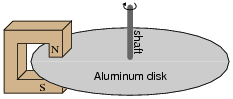
Explain the phenomenon behind this magnetic “drag” mechanism, and also explain how the permanent magnet assembly should be re-positioned so that it provides less drag on the disk for the same rotational speed.
Reveal answerThis is an example of Lenz’ Law. For decreased drag on the disk, the magnet needs to be moved over a spot on the disk that has less surface velocity (I’ll let you figure out where that might be).
Follow-up question: suppose you move a strong magnet past the surface of an aluminum disk. What will happen to the disk, if anything?
Notes:An important calibration adjustment on electromechanical wattmeter assemblies is the positioning of the “drag” magnet, making this question a very practical one. An interesting challenge for students is to ask them to sketch the flow of induced electric current in the disk as it rotates past the magnet!
The follow-up question is actually a preview of induction motor theory, and may be illustrated with a powerful (rare-earth) magnet and a metal coin (Japanese Yen, made of aluminum, work very well for this, being good electrical conductors and lightweight!).
-
Question 18 of 24
One context in which to understand Lenz’s Law is the well-known physical law called the Conservation of Energy, which states that energy can neither be created (from nothing) nor destroyed (to nothing). This well-founded law of physics is the general principle forbidding so-called “over-unity” or “free energy” machines, where energy would supposedly be produced from no source whatsoever.
Demonstrate that if Lenz’s Law were reversed, the Conservation of Energy principle would be violated. In other words, imagine what would happen if the effects of Lenz’s Law were exactly opposite in direction, and show how this would result in more energy produced by a system than what is input to that system.
Reveal answerThere are several ways to demonstrate this. Perhaps the easiest to visualize (from an energy perspective) is a rotary magnetic “drag” disk, where the perpendicular intersection of a magnetic field and an electrically conductive disk creates a resistive drag (opposing) torque when the disk is rotated. The effects of reversing the Lenz force direction should be obvious here.
Notes:This question may very well lead to a fruitful discussion on perpetual motion and claims of “free energy” machines, the very existence of such claims in modern times being outstanding evidence of scientific illiteracy. Not only do a substantial number of people seem ignorant of the Conservation of Energy principle and just how well it is founded, but also seem unable to grasp the importance of the ultimate test for such a device: to be able to power itself (and a load) indefinitely. But I digress . . .