Facebook
 Google
 GitHub
 Linkedin
DC Electric Circuits
Intermediate Electromagnetism and Electromagnetic Induction
24 questions By Tony R. Kuphaldt
-
Question 22 of 24
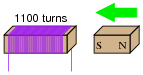
If a wire coil with 1100 turns is exposed to a magnetic flux increasing at a rate of 0.07 Webers per second (as shown in the illustration), how much voltage will be induced across the coil, and what will its polarity be?
Reveal answer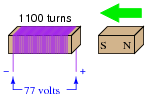
Notes:This question is both a quantitative application of Faraday’s Law and an application of Lenz’s Law.
-
Question 23 of 24
Calculate the necessary magnetic flux rate-of-change over time (in units of Webers per second) as well as the direction of magnet motion (either toward or away from the coil) to induce a voltage of 13.5 volts in the polarity shown:
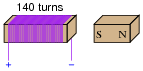
Reveal answer\(\frac{d φ}{dt}\) must be equal to 0.0964 Webers per second, with the magnet moving away from the coil.
Notes:This question is both a quantitative application of Faraday’s Law and an application of Lenz’s Law.
-
Question 24 of 24
If the motion of a conductor through a magnetic field induces a voltage in that conductor, it stands to reason that a conductive fluid moving through a pipe can also generate a voltage, if properly exposed to a magnetic field. Draw a picture showing the necessary orientation of the pipe, the magnetic field, and the electrodes intercepting the induced voltage.
Reveal answer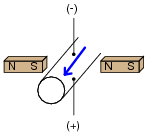
Notes:This question really tests students’ comprehension of the orthogonal relationships between magnetic flux, conductor motion, and induced voltage. Additionally, it reveals a novel method of producing electricity: magnetohydrodynamics.
There are a few interesting applications of magnetohydrodynamics, including power generation and flow measurement. Discuss these with your students if time permits.