Facebook
 Google
 GitHub
 Linkedin
DC Electric Circuits
Intermediate Electromagnetism and Electromagnetic Induction
24 questions By Tony R. Kuphaldt
-
Question 19 of 24
Based on your knowledge of Lenz’s Law, explain how one could construct an electromagnetic brake, whereby the energization of an electromagnet coil would produce mechanical “drag” on a rotating shaft without the need for contact between the shaft and a brake pad.
Reveal answer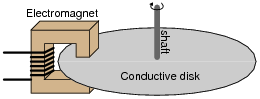
Follow-up question: describe some of the advantages and disadvantages that a magnetic brake would have, compared to mechanical brakes (where physical contact produces friction on the shaft).
Challenge question: normal (mechanical) brakes become hot during operation, due to the friction they employ to produce drag. Will an electromechanical brake produce heat as well, given that there is no physical contact to create friction?
Notes:Electromagnetic brakes are very useful devices in industry. One interesting application I’ve seen for this technology is the mechanical load for an automotive dynamometer, where a car is driven onto a set of steel rollers, with one roller coupled to a large metal disk (with electromagnets on either side). By varying the amount of current sent to the electromagnets, the degree of mechanical drag may be varied.
Incidentally, this disk becomes very hot when in use, because the automobile’s power output cannot simply vanish - it must be converted into a different form of energy in the braking mechanism, and heat it is.
-
Question 20 of 24
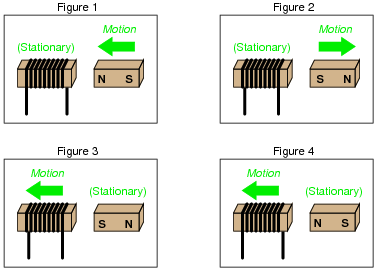
Determine the polarity of the coil’s induced voltage for each of the following examples. Be careful to note the direction each coil is wrapped around its core - the coils are not all identical!
Reveal answer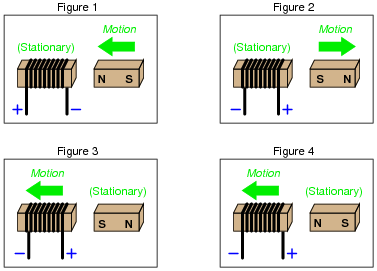
Notes:It might help students to visualize the polarity if they imagine a resistive load connected between the two output terminals, and then figured out which direction induced current would go through that load. Once that determination is made, voltage polarity (considering the coil as an energy source) should be easier to visualize. A mistake many beginning students make when doing this, though, is to fail to recognize the coil as the source of electrical energy and the resistor as the load, so be prepared to address this misunderstanding.
If this does not help, suggest they first identify the magnetic polarity of the coil’s induced field: determine which end of the coil is “trying” to be North and which is “trying” to be South. Of course, no induced field will form unless the coil has a complete circuit to sustain the induced current, but it is still helpful to imagine a load resistor or even a short completing the circuit so that induced current and thus induced magnetic polarity may be visualized.
-
Question 21 of 24
If a wire coil with 320 turns is exposed to a magnetic flux decreasing at a rate of 0.03 Webers per second (as shown in the illustration), how much voltage will be induced across the coil, and what will its polarity be?
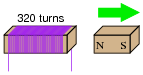
Reveal answer
Notes:This question is both a quantitative application of Faraday’s Law and an application of Lenz’s Law.