Facebook
 Google
 GitHub
 Linkedin
DC Electric Circuits
Intermediate Electromagnetism and Electromagnetic Induction
24 questions By Tony R. Kuphaldt
-
Question 4 of 24
Write an equation that expresses the amount of magnetic flux (Φ) produced by an electromagnet, given the amount of electric current (I), the number of turns in the wire coil (N), and the reluctance of the core material (ℜ).
Reveal answerΦ = NI ℜNotes:This is an exercise in algebraic substitution. Students are not likely to find this equation anywhere, so they’ll have to create it from a combination of two other equations.
-
Question 5 of 24
∫f(x) dx Calculus alert!
Plot the relative B-H curves for a sample of air and a sample of iron, in proportion to each other (as much as possible):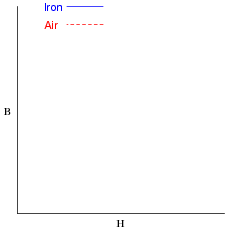
What do you notice about the slope (also called the derivative, or \(\frac{dB}{dH}\) of each plot?
Reveal answer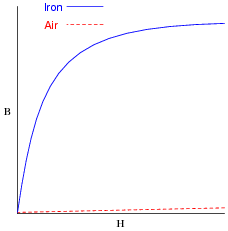
Follow-up question: note that the slope of both plots are approximately equal toward the far right end of the graph. Explain this effect in terms of magnetic saturation.
Notes:The purpose of this question is twofold: to get students to see that a ferromagnetic material such as iron is much more permeable (less “reluctant”) than air, but that the great gains in B realized by iron tend to disappear as soon as saturation sets in. Once the iron is saturated, the gains in B for equal advances in H are the same as for air. That is, the \(\frac{dB}{dH}\) for iron is equal to the \(\frac{dB}{dH}\) for air once the iron is saturated.
-
Question 6 of 24
If a wire coil with 450 turns is exposed to a magnetic flux increasing at a rate of 0.008 Webers per second, how much voltage will be induced across the coil?
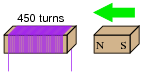
Reveal answer3.6 volts
Notes:This is simply a quantitative application of Faraday’s Law. There is no significance to the fact that the magnetic flux is increasing rather than decreasing. The only effect this would have on the induced voltage is its polarity.