Facebook
 Google
 GitHub
 Linkedin
Analog Integrated Circuits
Inverting and Noninverting OpAmp Voltage Amplifier Circuits
41 questions By Tony R. Kuphaldt
-
Question 10 of 41
What would have to be altered in this circuit to increase its overall voltage gain?

Reveal answerThe voltage divider would have to altered so as to send a smaller proportion of the output voltage to the inverting input.
Notes:Ask your students to explain how they would modify the voltage divider in this circuit to achieve the goal of a smaller voltage division ratio. This should be trivial, but it is always good to review basic principles of electricity even when “deep” into a more advanced topic.
-
Question 11 of 41
The equation for voltage gain (AV) in a typical non-inverting, single-ended opamp circuit is as follows:
AV = R1 R21 Where,
R1 is the feedback resistor (connecting the output to the inverting input)
R2 is the other resistor (connecting the inverting input to ground)
Suppose we wished to change the voltage gain in the following circuit from 5 to 6.8, but only had the freedom to alter the resistance of R2:

Algebraically manipulate the gain equation to solve for R2, then determine the necessary value of R2 in this circuit to give it a voltage gain of 6.8.
Reveal answerR2 = R1 AV − 1For the circuit shown, R2 would have to be set equal to 810.3 Ω.
Notes:Nothing more than a little algebra to obtain the answers for this question!
-
Question 12 of 41
Calculate the necessary resistor value (R1) in this circuit to give it a voltage gain of 30:
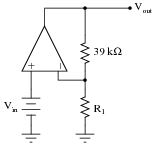
Reveal answerR1 = 1.345 kΩ
Notes:Ask your students how they solved this problem, especially since it is fairly safe to say that they didn’t find the equation directly solving for R1 in any book. Algebraic manipulation is necessary to take the standard voltage gain equation and put it into a form suitable for use answering this question.