
 Facebook
 Google
 GitHub
 Linkedin
DC Electric Circuits
Kirchhoff’s Laws
48 questions By Tony R. Kuphaldt
-
Question 4 of 48
Suppose a technician is checking the operation of the following electronic circuit:
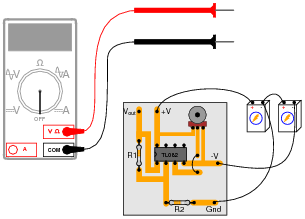
She decides to measure the voltage on either side of resistor R1 with reference to ground, and obtains these readings:
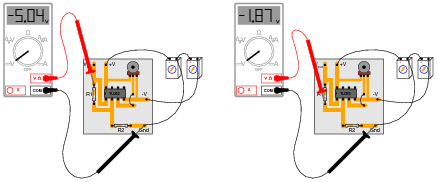
On the top side of R1, the voltage with reference to ground is -5.04 volts. On the bottom side of R1, the voltage with reference to ground is -1.87 volts. The color code of resistor R1 is Yellow, Violet, Orange, Gold. From this information, determine the following:
- • Voltage across R1 (between top to bottom):
- • Polarity ( and -) of voltage across R1:
- • Current (magnitude) through R1:
- • Direction of current through R1:
Additionally, explain how this technician would make each one of these determinations. What rules or laws of electric circuits would she apply?
Reveal answer- Voltage across R1 (between top to bottom): 3.17 volts
- Polarity (+ and -) of voltage across R1: (-) on top, (+) on bottom
- Current (magnitude) through R1: 67.45 μA
- Direction of current through R1: upward, following conventional flow
Follow-up question: calculate the range of possible currents, given the specified tolerance of resistor R1 (67.45 μA assumes 0% error).
Challenge question: if you recognize the type of circuit this is (by the part number of the IC “chip”: TL082), identify the voltage between pin 3 and ground.
Notes:This is a good example of how Kirchhoff’s Voltage Law is more than just an abstract tool for mathematical analysis - it is also a powerful technique for practical circuit diagnosis. Students must apply KVL to determine the voltage drop across R1, and then use Ohm’s Law to calculate its current.
If students experience difficulty visualizing how KVL plays a part in the solution of this problem, show them this illustration:

By the way, the answer to the challenge question may only be realized if students recognize this circuit as a noninverting opamp voltage amplifier. The voltage at pin 3 (noninverting input) will be the same as the voltage at pin 2 (inverting input): -1.87 volts.
-
Question 5 of 48
Calculate the amount of voltage between points A and B in this circuit. Be sure to identify polarity as well as magnitude:

Reveal answerVAB = 9.198 volts, A positive and B negative.
Notes:Nothing here but series-parallel calculation practice, combined with KVL. Ask your students to explain how they calculated this voltage, because there is definitely more than one way to do it!
-
Question 6 of 48
Calculate the amount of voltage between points A and B in this circuit. Be sure to identify polarity as well as magnitude:

Reveal answerVAB = 6.148 volts, A negative and B positive.
Notes:Nothing here but series-parallel calculation practice, combined with KVL. Ask your students to explain how they calculated this voltage, because there is definitely more than one way to do it!






I think there is a mistake in question 28 more specifically step 3 and 4. I think their answers are switched. Step 3 should be 12 and Step 4 should be -24
In the notes for question 4, the diagram should have a 47k resistor, not 4.7k.