
 Facebook
 Google
 GitHub
 Linkedin
DC Electric Circuits
Kirchhoff’s Laws
48 questions By Tony R. Kuphaldt
-
Question 7 of 48
Determine the polarity of voltage across the resistor in this simple circuit, and be prepared to explain how you did so:

Reveal answer
Notes:The answer to this question is fairly trivial, but the real point of it is to get students thinking about how and why it is the way it is. One thing I’ve noticed as an instructor of electronics is that most students tend to follow the rule of proximity: the resistor’s voltage drop polarity is determined by proximity to poles of the battery. The resistor terminal closest to the battery’s negative terminal must be negative as well, or so the thinking goes. While this is sound reasoning in a simple circuit such as this, it can lead to confusion in circuits where there is more than one power source at work!
-
Question 8 of 48
Determine the polarity of voltage across the resistor in this simple circuit, and be prepared to explain how you did so:

Reveal answer
Follow-up question: are the battery voltage values important to the answer? Explain why or why not.
Notes:The answer to this question is fairly simple, but the real point of it is to get students thinking about how and why it is the way it is. One thing I’ve noticed as an instructor of electronics is that most students tend to follow the rule of proximity: the resistor’s voltage drop polarity is determined by proximity to poles of the battery. The resistor terminal closest to the battery’s negative terminal must be negative as well, or so the thinking goes.
In this particular circuit, though, the rule of proximity does not hold very well, and a different rule is necessary.
-
Question 9 of 48
Determine both the polarity of voltage across the resistor in this circuit, and how much voltage will be dropped across the resistor:

Explain the procedure(s) you used to answer both these questions.
Reveal answer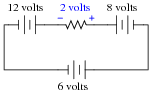
Notes:The answer to this question is fairly simple, but the real point of it is to get students thinking about how and why it is the way it is. One thing I’ve noticed as an instructor of electronics is that most students tend to follow the rule of proximity: the resistor’s voltage drop polarity is determined by proximity to poles of the battery. The resistor terminal closest to the battery’s negative terminal must be negative as well, or so the thinking goes.
In this particular circuit, though, the rule of proximity does not hold very well, and a different rule is necessary.







I think there is a mistake in question 28 more specifically step 3 and 4. I think their answers are switched. Step 3 should be 12 and Step 4 should be -24
In the notes for question 4, the diagram should have a 47k resistor, not 4.7k.