
 Facebook
 Google
 GitHub
 Linkedin
DC Electric Circuits
Kirchhoff’s Laws
48 questions By Tony R. Kuphaldt
-
Question 40 of 48
Predict how all component voltages and currents in this circuit will be affected as a result of the following faults. Consider each fault independently (i.e. one at a time, no multiple faults):
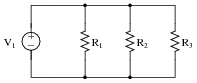
- Voltage source V1 fails with increased output: Resistor R1 fails open: Resistor R3 fails open: Solder bridge (short) across resistor R2:
For each of these conditions, explain why the resulting effects will occur.
Reveal answer- Voltage source V1 fails with increased output: All resistor currents increase, all resistor voltages increase, current through V1 increases. Resistor R1 fails open: All resistor voltages remain unchanged, current through R1 decreases to zero, currents through R2 and R3 remain unchanged, current through V1 decreases by the amount that used to go through R1. Resistor R3 fails open: All resistor voltages remain unchanged, current through R3 decreases to zero, currents through R1 and R2 remain unchanged, current through V1 decreases by the amount that used to go through R3.
Solder bridge (short) across resistor R2: Theoretically, all resistor voltages remain unchanged while a near-infinite amount of current goes through the shorted R2. Realistically, all resistor voltages will decrease to nearly zero while the currents through R2 and V1 will increase dramatically.
Notes:The purpose of this question is to approach the domain of circuit troubleshooting from a perspective of knowing what the fault is, rather than only knowing what the symptoms are. Although this is not necessarily a realistic perspective, it helps students build the foundational knowledge necessary to diagnose a faulted circuit from empirical data. Questions such as this should be followed (eventually) by other questions asking students to identify likely faults based on measurements.
-
Question 41 of 48
Predict how all component voltages and currents in this circuit will be affected as a result of the following faults. Consider each fault independently (i.e. one at a time, no multiple faults):
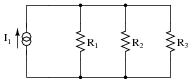
- Current source I1 fails with increased output: Resistor R1 fails open: Resistor R3 fails open: Solder bridge (short) across resistor R2:
For each of these conditions, explain why the resulting effects will occur.
Reveal answer- Current source I1 fails with increased output: All resistor currents increase, all resistor voltages increase, voltage across I1 increases. Resistor R1 fails open: All resistor voltages increase, current through R1 decreases to zero, currents through R2 and R3 increase, current through I1 remains unchanged, voltage across I1 increases. Resistor R3 fails open: All resistor voltages increase, current through R3 decreases to zero, currents through R1 and R2 increase, current through I1 remains unchanged, voltage across I1 increases.
Solder bridge (short) across resistor R2: All resistor voltages decrease to zero, currents through R1 and R3 decrease to zero, current through shorted R2 increases to equal I1, current through I1 remains unchanged, voltage across I1 decreases to zero.
Notes:The purpose of this question is to approach the domain of circuit troubleshooting from a perspective of knowing what the fault is, rather than only knowing what the symptoms are. Although this is not necessarily a realistic perspective, it helps students build the foundational knowledge necessary to diagnose a faulted circuit from empirical data. Questions such as this should be followed (eventually) by other questions asking students to identify likely faults based on measurements.
-
Question 42 of 48
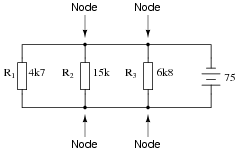
Calculate and label the currents at each node (junction point) in this circuit:
Reveal answer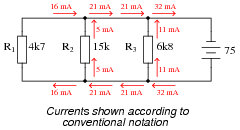
Notes:Discuss with your students techniques for calculating the node currents. What Laws did your students apply, and more importantly, in what order did they apply them?




I think there is a mistake in question 28 more specifically step 3 and 4. I think their answers are switched. Step 3 should be 12 and Step 4 should be -24
In the notes for question 4, the diagram should have a 47k resistor, not 4.7k.