
 Facebook
 Google
 GitHub
 Linkedin
DC Electric Circuits
Kirchhoff’s Laws
48 questions By Tony R. Kuphaldt
-
Question 22 of 48
Imagine you are using a digital voltmeter to measure voltages between pairs of points in a circuit, following the sequence of steps shown in these diagrams:
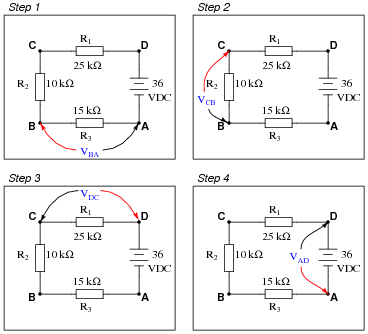
How much voltage would be registered by the voltmeter in each of the steps? Be sure to include the sign of the DC voltage measured (note the coloring of the voltmeter leads, with the red lead always on the first point denoted in the subscript: VBA = red lead on “B” and black lead on Ä”):
- VBA =
- VCB =
- VDC =
- VAD =
What is the algebraic sum of these voltages?
Reveal answer- VBA = 10.8 volts
- VCB = 7.2 volts
- VDC = 18 volts
- VAD = −36 volts
Notes:Ask your students this question: “Will the algebraic sum of voltage measurements ever be other than zero in a loop?” Ask them to explain why this is, as best they can.
-
Question 23 of 48
Imagine you are using a digital voltmeter to measure voltages between pairs of points in a circuit, following the sequence of steps shown in these diagrams:
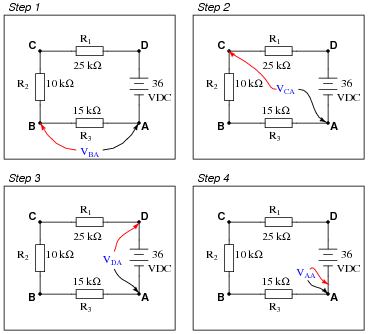
How much voltage would be registered by the voltmeter in each of the steps? Be sure to include the sign of the DC voltage measured (note the coloring of the voltmeter leads, with the red lead always on the first point denoted in the subscript: VBA = red lead on “B” and black lead on “A”):
- VBA =
- VCA =
- VDA =
- VAA =
Challenge question: how do these voltage measurements prove Kirchhoff’s Voltage Law, where the algebraic sum of all voltages in a loop equals 0 volts?
Reveal answer- VBA = 10.8 volts
- VCA = 18.0 volts
- VDA = 36.0 volts
- VAA = 0 volts
With each successive step, one more voltage is being added to the previously measured voltage(s), as the meter measures across a larger series chain of resistors. Ultimately,
VAA = VAD VDC VCB VBA = 0 volts Notes:Building on the knowledge of series voltages being additive, this example serves as a simple proof of Kirchhoff’s Voltage Law. At the final step of the sequence, the voltage indicated by the meter must be zero volts because the two test leads are now electrically common to each other.
-
Question 24 of 48
Identify each of the specified voltages in the following circuit. The subscripts refer to the specific test points (where the red test lead of the voltmeter touches the circuit), while ground is the point where the voltmeter’s black lead is assumed to be attached:

For example, VB means the voltage indicated by a voltmeter with the red test lead touching point B and the black test lead touching ground.
- VA =
- VB =
- VC =
- VD =
- VE =
Reveal answer- VA = 16 volts
- VB = 16 volts
- VC = 10 volts
- VD = 0 volts
- VE = -2 volts
Follow-up question: explain how it is possible to determine that VA and VB will be exactly the same value, prior to performing any mathematical calculations.
Notes:This question helps to familiarize students with the concept of “ground” as the default reference point for taking voltage measurements, as well as being an application of Kirchhoff’s Voltage Law.




I think there is a mistake in question 28 more specifically step 3 and 4. I think their answers are switched. Step 3 should be 12 and Step 4 should be -24
In the notes for question 4, the diagram should have a 47k resistor, not 4.7k.