
 Facebook
 Google
 GitHub
 Linkedin
DC Electric Circuits
Kirchhoff’s Laws
48 questions By Tony R. Kuphaldt
-
Question 37 of 48
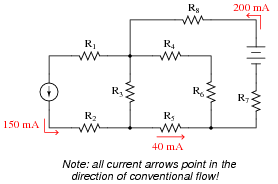
Use Kirchhoff’s Current Law to calculate the magnitudes and directions of currents through all resistors in this circuit:
Reveal answer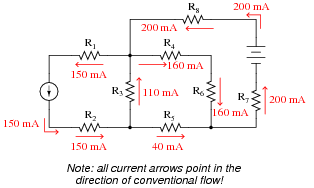
Notes:It is not necessary to know anything about series-parallel or even parallel circuits in order to solve the R4‘s current - all one needs to know is how to use Kirchhoff’s Current Law.
-
Question 38 of 48
Predict how all component voltages and currents in this circuit will be affected as a result of the following faults. Consider each fault independently (i.e. one at a time, no multiple faults):

- Voltage source V1 fails with increased output: Solder bridge (short) across resistor R1: Solder bridge (short) across resistor R2: Resistor R3 fails open:
For each of these conditions, explain why the resulting effects will occur.
Reveal answer- Voltage source V1 fails with increased output: All resistor currents increase, all resistor voltages increase, current through V1 increases. Solder bridge (short) across resistor R1: All resistor currents increase, voltage across resistors R2 and R3 increase, voltage across resistor R1 decreases to zero, current through V1 increases. Solder bridge (short) across resistor R2: All resistor currents increase, voltage across resistors R1 and R3 increase, voltage across resistor R2 decreases to zero, current through V1 increases.
Resistor R3 fails open: All resistor currents decrease to zero, voltages across R1 and R2 decrease to zero, voltage across R3 increases to equal V1.
Notes:The purpose of this question is to approach the domain of circuit troubleshooting from a perspective of knowing what the fault is, rather than only knowing what the symptoms are. Although this is not necessarily a realistic perspective, it helps students build the foundational knowledge necessary to diagnose a faulted circuit from empirical data. Questions such as this should be followed (eventually) by other questions asking students to identify likely faults based on measurements.
-
Question 39 of 48
Predict how all component voltages and currents in this circuit will be affected as a result of the following faults. Consider each fault independently (i.e. one at a time, no multiple faults):

- Current source I1 fails with increased output: Solder bridge (short) across resistor R1: Solder bridge (short) across resistor R2: Resistor R3 fails open:
For each of these conditions, explain why the resulting effects will occur.
Reveal answer- Current source I1 fails with increased output: All resistor currents increase, all resistor voltages increase, voltage across I1 increases. Solder bridge (short) across resistor R1: All resistor currents remain unchanged, voltage across resistor R1 decreases to zero, voltage across I1 decreases by the amount R1 previously dropped. Solder bridge (short) across resistor R2: All resistor currents remain unchanged, voltage across resistor R2 decreases to zero, voltage across I1 decreases by the amount R2 previously dropped.
Resistor R3 fails open: Theoretically, all resistor currents remain unchanged while a large arc jumps across the failed-open R3 (and possibly across I1 as well). Realistically, all resistor currents will decrease to zero while the voltages across R3 and I1 will increase to maximum.
Notes:The purpose of this question is to approach the domain of circuit troubleshooting from a perspective of knowing what the fault is, rather than only knowing what the symptoms are. Although this is not necessarily a realistic perspective, it helps students build the foundational knowledge necessary to diagnose a faulted circuit from empirical data. Questions such as this should be followed (eventually) by other questions asking students to identify likely faults based on measurements.



I think there is a mistake in question 28 more specifically step 3 and 4. I think their answers are switched. Step 3 should be 12 and Step 4 should be -24
In the notes for question 4, the diagram should have a 47k resistor, not 4.7k.