
 Facebook
 Google
 GitHub
 Linkedin
DC Electric Circuits
Kirchhoff’s Laws
48 questions By Tony R. Kuphaldt
-
Question 10 of 48
Determine what a digital voltmeter (DVM) would indicate if connected between the following points in this circuit:
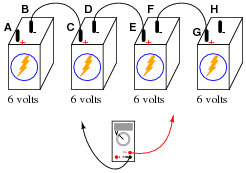
- Red lead on A, black lead on H
- Red lead on C, black lead on G
- Red lead on F, black lead on B
- Red lead on F, black lead on A
Reveal answerHere is a schematic diagram to help you:

- Red lead on A, black lead on H = 24 volts
- Red lead on C, black lead on G = 12 volts
- Red lead on F, black lead on B = -12 volts
- Red lead on F, black lead on A = -18 volts
Notes:Kirchhoff’s Voltage Law (KVL) is very easily explored in real life with a set of batteries and “jumper wire” connections. Encourage your students to build battery circuits like the one shown in this question, to be able to see the results for themselves!
One really nice feature of digital multimeters (DMMs) is the ability to register negative as well as positive quantities. This feature is very useful when teaching Kirchhoff’s Laws, with the algebraic (sign-dependent) summation of voltages and currents.
-
Question 11 of 48
Determine what a digital voltmeter (DVM) would indicate if connected between the following points in this circuit:
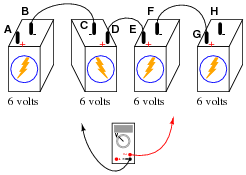
- Red lead on A, black lead on H
- Red lead on C, black lead on G
- Red lead on F, black lead on B
- Red lead on F, black lead on A
Reveal answerHere is a schematic diagram to help you:

- Red lead on A, black lead on H = 12 volts
- Red lead on C, black lead on G = 0 volts
- Red lead on F, black lead on B = 0 volts
- Red lead on F, black lead on A = -6 volts
Notes:Kirchhoff’s Voltage Law (KVL) is very easily explored in real life with a set of batteries and “jumper wire” connections. Encourage your students to build battery circuits like the one shown in this question, to be able to see the results for themselves!
One really nice feature of digital multimeters (DMMs) is the ability to register negative as well as positive quantities. This feature is very useful when teaching Kirchhoff’s Laws, with the algebraic (sign-dependent) summation of voltages and currents.
Students may arrive at more than one method for determining voltmeter indications in problems like these. Encourage this type of creativity during discussion time, as it both helps students gain confidence in being able to approach problems on their own terms, as well as educates those students who might be confused with the concept. Quite often the explanation of a peer is more valuable than the explanation of an instructor. When students are given the freedom to explore problem-solving methods, and then share those methods with their classmates, substantial learning always results.
-
Question 12 of 48
A barometric altimeter is a device used to measure altitude (height) by means of atmospheric pressure. The higher you go up from sea level, the less air pressure you encounter. This decrease in air pressure is closely correlated with height, and thus can be used to infer altitude.
This type of altimeter usually comes equipped with a “zero” adjustment, so that the instrument’s indication may be offset to compensate for changes in air pressure resulting from different weather conditions. This same “zero” adjustment may also be used to establish the altimeter’s zero indication at any arbitrary height.
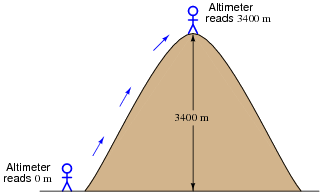
For example, if a mountain climber sets her barometric altimeter to zero meters at the base of a mountain, then climbs to the summit of that mountain (3400 meters higher than the base), the altimeter should register 3400 meters at the summit:
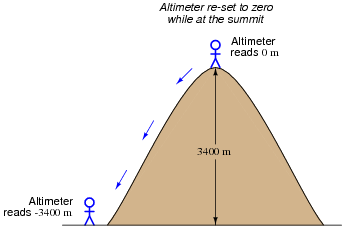
While at the summit, the climber may re-set the altimeter’s “zero” adjustment to register 0 meters once again. If the climber then descends to the base of the mountain, the altimeter will register -3400 meters:
Explain how this scenario of mountain climbing and altimeter calibration relates to the measurement of voltage between points A and B in the following circuit:

Reveal answerThe voltmeter’s black lead is analogous to the “zero reference” level in the mountain-climbing altimeter scenario: the point at which the altimeter is calibrated to register 0 meters height.
Notes:Physical height (and depth) is a very useful analogy for electrical potential, helping students relate this abstract thing called “voltage” to more common differential measurements.






I think there is a mistake in question 28 more specifically step 3 and 4. I think their answers are switched. Step 3 should be 12 and Step 4 should be -24
In the notes for question 4, the diagram should have a 47k resistor, not 4.7k.