
 Facebook
 Google
 GitHub
 Linkedin
DC Electric Circuits
Kirchhoff’s Laws
48 questions By Tony R. Kuphaldt
-
Question 31 of 48
How much water must flow out of the pipe with the question-mark symbols next to it?
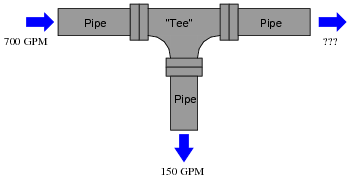
Explain how this hydraulic example relates to Kirchhoff’s Current Law (KCL) in an electric circuit.
Reveal answer550 gallons per minute (“GPM”), assuming no leaks in the pipe.
Notes:Ask your students to draw an electric circuit schematic showing how the same principle illustrated in the hydraulic system would apply to electric current, with “flow rates” of 700 amps, 150 amps, and 550 amps, respectively.
-
Question 32 of 48
In this circuit there is at least one ammeter that is not reading correctly:
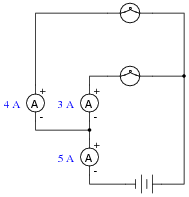
Apply Kirchhoff’s Current Law to this circuit to prove why all three current measurements shown here cannot be correct.
Reveal answerKirchhoff’s Current Law renders this scenario impossible: “the algebraic sum of all currents at a node must be zero.”
Notes:Another way of stating KCL is to say, “What goes in must come out.” When continuous DC currents are involved, this law is really nothing more than a restatement of the Conservation of Charge. Of course, there are transient exceptions to this law (static electric charge and discharge, for example) as well as interesting AC exceptions (current “through” a capacitor), so a hard-literal interpretation of KCL may cause confusion later one. However, it is a fairly intuitive Law to grasp, and consequently I seldom find students experiencing difficulty with it.
-
Question 33 of 48
A voltage source is a source of electricity that (ideally) outputs a constant voltage. That is, a perfect voltage source will hold its output voltage constant regardless of the load imposed upon it:

In real life, there is no such thing as a perfect voltage source, but sources having extremely low internal resistance come close.
Another type of electricity source is the current source, which (ideally) outputs a constant current regardless of the load imposed upon it. A common symbol for a current source is a circle with an arrow inside (always pointing in the direction of conventional flow, not electron flow!). Another symbol is two intersecting circles, with an arrow nearby pointing in the direction of conventional flow:

Predict how an ideal current source would behave for the following two load scenarios:

Reveal answer
Follow-up question: identify the polarity of the voltage drops across the resistors in the circuits shown above.
Notes:Let students know that there really is such a thing as a perfect current source, just as there is no such thing as a perfect voltage source. However, there are devices the closely approximate ideal current sources (current transformers in AC circuits and “current mirror” DC transistor circuits, for example).



I think there is a mistake in question 28 more specifically step 3 and 4. I think their answers are switched. Step 3 should be 12 and Step 4 should be -24
In the notes for question 4, the diagram should have a 47k resistor, not 4.7k.