
 Facebook
 Google
 GitHub
 Linkedin
DC Electric Circuits
Kirchhoff’s Laws
48 questions By Tony R. Kuphaldt
-
Question 13 of 48
Determine the amount of voltage measured at points A and B with reference to ground, and also determine voltage VAB (defined here as the voltage indicated by a voltmeter with the red test lead touching point A and the black test lead touching point B):

Reveal answerVA = 9 volts
VB = 6 volts
VAB = 3 volts
Follow-up question: explain why the mathematical signs (” ”) are important in these answers.
Notes:Determining differential voltages is a skill that many students find frustrating to attain. There is more than one way to explain how to arrive at 3 volts as the answer for VAB, and it is good for students to see more than one way presented.
-
Question 14 of 48
A student is puzzled by a problem given by her instructor. The task is to determine the voltage VAB (defined by the instructor as the voltage indicated by a voltmeter with the red test lead touching point A and the black test lead touching point B) in this circuit:

The student has already figured out that VA = 9 V and VB = −6 V, but does not know for certain how to calculate the voltage between points A and B. Asking her instructor for an explanation, the instructor begins to draw this illustration:
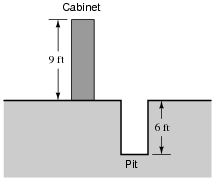
Before the instructor begins to explain what the illustration means, however, he receives a call on his telephone and must leave the student momentarily. The student then asks you to help explain what the instructor’s illustration might mean, and how it applies to the problem of determining voltage VAB in the original circuit.
What would your explanation be? Where do you think the instructor was going with this illustration, and how it might relate to voltages in a circuit?
Reveal answerThe height of the cabinet (above ground) represents the positive voltage at point A, while the depth of the pit (below ground) represents the negative voltage at point B. The difference in altitude between the cabinet’s height and the pit’s depth represents the voltage VAB in the circuit.
Notes:It may be good to remind your students that voltage is and forever will be a quantity between two points and never defined at a single point. The only reason we can say VA = 9 volts and VB = −6 volts is because there is a ground point in the circuit, which by convention is the point of reference for any voltages defined at other, single points in the circuit.
-
Question 15 of 48
Determine the voltages registered by a voltmeter between the following points in this circuit:

VA = (red lead on A, black lead on ground)
VB = (red lead on B, black lead on ground)
VC = (red lead on C, black lead on ground)
VD = (red lead on D, black lead on ground)
VAC = (red lead on A, black lead on C)
VDB = (red lead on D, black lead on B)
VBA = (red lead on B, black lead on A)
VBC = (red lead on B, black lead on C)
VCD = (red lead on C, black lead on D)
Reveal answerVA = 30 volts (red lead on A, black lead on ground)
VB = 3 volts (red lead on B, black lead on ground)
VC = 9 volts (red lead on C, black lead on ground)
VD = -15 volts (red lead on D, black lead on ground)
VAC = 21 volts (red lead on A, black lead on C)
VDB = -18 volts (red lead on D, black lead on B)
VBA = -27 volts (red lead on B, black lead on A)
VBC = -6 volts (red lead on B, black lead on C)
VCD = 24 volts (red lead on C, black lead on D)
Notes:Discuss with your students multiple techniques of solving for these voltages, asking them first for their solution strategies.





I think there is a mistake in question 28 more specifically step 3 and 4. I think their answers are switched. Step 3 should be 12 and Step 4 should be -24
In the notes for question 4, the diagram should have a 47k resistor, not 4.7k.