Facebook
 Google
 GitHub
 Linkedin
Network Analysis Techniques
Millman’s Theorem
9 questions By Tony R. Kuphaldt
-
Question 7 of 9
What would a digital voltmeter register, if connected to the circuit as shown below?
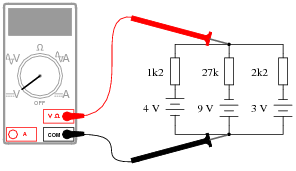
Reveal answerIf you calculated 3.797 volts, you made a mistake! In actuality, the voltmeter would register 1.235 volts.
Notes:A very common mistake I’ve seen students make is to disregard polarities when using Millman’s theorem. If this appears to be a common problem in your class, ask your students if they think reversing one of the voltage source polarities would have any effect on the “bus” voltage. Of course, it should. Once students understand that polarity is significant, they can arrive at their own consistent approach to accounting for polarity in the Millman’s theorem equation.
Another strategy for getting students to understand the significance of polarity when using Millman’s theorem is to go back to the foundations of Millman’s theorem: the principle of converting Thévenin sources into Norton sources. If a Thévenin source with a “backwards” battery is converted into a Norton source, that current source will subtract current from the rest of the current sources, leaving less to go through the total Norton resistance. Students should be able to readily understand the principle of Norton current sources adding versus subtracting, and this should then carry over into their use of the Millman’s theorem equation.
-
Question 8 of 9
A set of batteries are connected in parallel to form a battery bank. Ideally, their individual voltages would be exactly equal, and there would be no stray resistance anywhere in the circuit, but in reality what we have is something like this:

Use Millman’s theorem to calculate the total voltage between the two busses for the battery bank, given these specifications for the four batteries:
Battery Voltage Rconnection Rconnection − Rinternal
1 11.9 1.2 Ω 1.1 Ω 5.5 Ω
2 12.2 1.0 Ω 1.3 Ω 5.1 Ω
3 12.0 1.4 Ω 0.9 Ω 4.7 Ω
4 12.1 1.1 Ω 1.2 Ω 5.5 Ω
Reveal answerBus voltage = 12.051 V
Notes:Millman’s theorem is especially useful in making bus voltage calculations for power systems, where multiple sources (and loads!) are connected to the same two wires.
-
Question 9 of 9
Calculate the voltage across the starter motor terminals of the “dead” car, and the current through the starter motor, while a second car is giving it a jump-start:
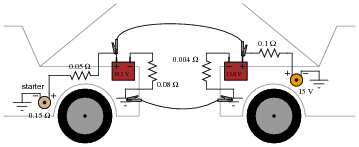
Regard the starter motor itself as a 0.15 Ω resistor, and disregard any resistance of the jumper cables connecting the two cars’ electrical systems together.
Reveal answerEmotor = 9.534 V
Imotor = 63.56 A
Notes:For a question like this, where an equivalent schematic diagram is essential to obtaining the solution, I recommend you have a student draw their equivalent schematic on the whiteboard in front of the class, and discuss the diagram with all your students before discussing how to apply Millman’s theorem.
I have found it helpful for students to have them draw diagrams and mathematical solutions on a board in front of the rest of the class. Of course, you as the instructor must be careful to maintain a non-threatening environment in the classroom while students do this, as it tends to place a lot of stress on shy students. However, the ability to present graphical information to a group is a valuable skill, and exercises like this help to build it in your students.