Facebook
 Google
 GitHub
 Linkedin
AC Electric Circuits
Mixed-Frequency Signals
31 questions By Tony R. Kuphaldt
-
Question 22 of 31
∫f(x) dx Calculus alert!
If both these circuits are energized by an AC sine-wave source providing a perfectly undistorted signal, the resulting output waveforms will differ in phase and possibly in amplitude, but not in shape:
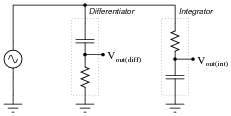
If, however, the excitation voltage is slightly distorted, one of the outputs will be more sinusoidal than the other. Explain whether it is the differentiator or the integrator that produces the signal most resembling a pure sine wave, and why.
Hint: I recommend building this circuit and powering it with a triangle wave, to simulate a mildly distorted sine wave.
Reveal answerThe differentiator circuit will output a much more distorted waveshape, because differentiation magnifies harmonics:
d dt( sin t ) = cos t d dt( sin 2t ) = 2 cos 2t d dt( sin 3t ) = 3 cos 3t d dt( sin 4t ) = 4 cos 4t … d dt( sin nt ) = n cos nt Notes:As an interesting footnote, this is precisely why differentiation is rarely performed on real-world signals. Since the frequency of noise often exceeds the frequency of the signal, differentiating a “noisy” signal will only lead to a decreased signal-to-noise ratio.
For a practical example of this, tell your students about vibration measurement, where it is more common to calculate velocity based on time-integration of an acceleration signal than it is to calculate acceleration based on time-differentiation of a velocity signal.
-
Question 23 of 31
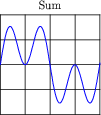
Note the effect of adding the second harmonic of a waveform to the fundamental, and compare that effect with adding the third harmonic of a waveform to the fundamental:
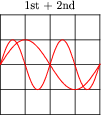
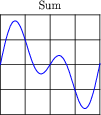
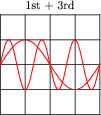
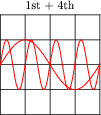
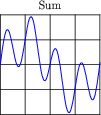
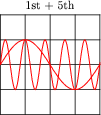
Now compare the sums of a fundamental with its fourth harmonic, versus with its fifth harmonic:
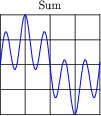
And again for the 1st 6th, versus the 1st 7th harmonics:
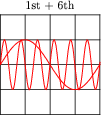
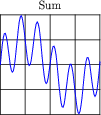
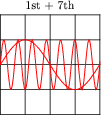
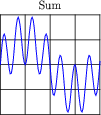
Examine these sets of harmonic sums, and indicate the trend you see with regard to harmonic number and symmetry of the final (Sum) waveforms. Specifically, how does the addition of an even harmonic compare to the addition of an odd harmonic, in terms of final waveshape?
Reveal answerThe addition of an even harmonic introduces asymmetry about the horizontal axis. The addition of odd harmonics does not.
Challenge question: explain why this is the case, any way you can.
Notes:Although the sequence of images presented in the question by no means constitutes a formal proof, it should lead students to observe a trend: that odd harmonics do not make a waveform unsymmetrical about the horizontal axis, whereas even harmonics do. Given these two facts, we may make qualitative judgments about the harmonic content of a waveform simply by visually checking for symmetry about the horizontal axis.
Incidentally, some students have a difficult time grasping the concept of symmetry about the horizontal axis of a waveform. Take this simple example, which is symmetrical about its horizontal centerline:
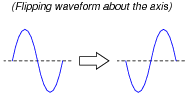
Some students will protest that this waveform is not symmetrical about its centerline, because it does not look exactly the same as before after flipping. They must bear in mind, though, that this is just one cycle of a continuous waveform. In reality, the waveform looks like this before and after flipping:
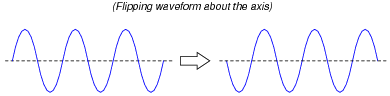
All one needs to do to see that these two waveforms are indeed identical is to do a 180 degree phase shift (shifting either to the left or to the right):
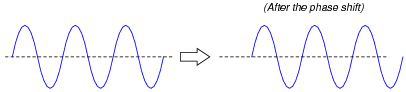
By contrast, a waveform without symmetry about the horizontal axis cannot be made to look the same after flipping, no matter what subsequent phase shift is given to it:
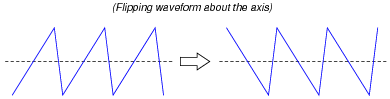
Another way to describe this asymmetry is in terms of the waveform’s departure from the centerline, compared to its return to the centerline. Is the rate-of-change ([dv/dt] for a voltage waveform) equal in magnitude and opposite in sign at each of these points, or is there a difference in magnitude as well? Discuss ways to identify this type of asymmetry, and what it means in terms of harmonic content.
Mathematically, this symmetry is defined as such:
f(t) = −f ( t + T 2) Where,
f(t) = Function of waveform with time as the independent variable
t = Time
T = Period of waveform, in same units of time as t
-
Question 24 of 31
When technicians and engineers consider harmonics in AC power systems, they usually only consider odd-numbered harmonic frequencies. Explain why this is.
Reveal answerNonlinear loads are usually (but not always!) symmetrical in their distortion.
Notes:I’ve had electrical power system experts confidently tell me that even-numbered harmonics cannot exist in AC power systems, due to some deep mathematical principle mysteriously beyond their ability to describe or explain. Rubbish! Even-numbered harmonics can and do appear in AC power systems, although they are typically much lower in amplitude than the odd-numbered harmonics due to the nature of most nonlinear loads.
If you ever wish to prove the existence of even-numbered harmonics in a power system, all you have to do is analyze the input current waveform of a half-wave rectifier!
Related Tools:
- Intermediate Electromagnetism and Electromagnetic Induction
- Performance-Based Assessments for Network Analysis Competencies