Facebook
 Google
 GitHub
 Linkedin
AC Electric Circuits
Mixed-Frequency Signals
31 questions By Tony R. Kuphaldt
-
Question 25 of 31
By visual inspection, determine which of the following waveforms contain even-numbered harmonics:
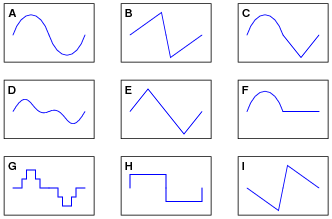
Note that only one cycle is shown for each waveform. Remember that we’re dealing with continuous waveforms, endlessly repeating, and not single cycles as you see here.
Reveal answerThe following waveforms contain even-numbered harmonics: B, C, D, F, and I. The rest only contain odd harmonics of the fundamental.
Notes:Ask your students how they were able to discern the presence of even-numbered harmonics by visual inspection. This typically proves difficult for some of my students whose spatial-relations skills are weak. These students need some sort of algorithmic (step-by-step) procedure to see what other students see immediately, and discussion time is a great opportunity for students to share technique.
Mathematically, this symmetry is defined as such:
f(t) = −f ( t + T 2) Where,
f(t) = Function of waveform with time as the independent variable
t = Time
T = Period of waveform, in same units of time as t
-
Question 26 of 31
By visual inspection, determine which of the following waveforms contain even-numbered harmonics:
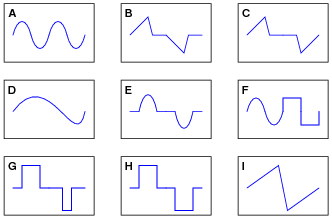
Note that only one cycle is shown for each waveform. Remember that we’re dealing with continuous waveforms, endlessly repeating, and not single cycles as you see here.
Reveal answerThe following waveforms contain even-numbered harmonics: C, D, G, and I. The rest only contain odd harmonics of the fundamental.
Notes:Ask your students how they were able to discern the presence of even-numbered harmonics by visual inspection. This typically proves difficult for some of my students whose spatial-relations skills are weak. These students need some sort of algorithmic (step-by-step) procedure to see what other students see immediately, and discussion time is a great opportunity for students to share technique.
Mathematically, this symmetry is defined as such:
f(t) = −f ( t + T 2) Where,
f(t) = Function of waveform with time as the independent variable
t = Time
T = Period of waveform, in same units of time as t
-
Question 27 of 31
A crude measurement circuit for harmonic content of a signal uses a notch filter tuned to the fundamental frequency of the signal being measured. Examine the following circuit and then explain how you think it would work:
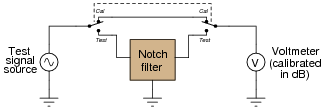
Reveal answerIf the signal source is pure (no harmonics), the voltmeter will register nothing (negative infinite decibels) when the switch is flipped to the “test” position.
Notes:This test circuit relies on the assumption that the notch filter is perfect (i.e. that its attenuation in the stop-band is complete). Since no filter is perfect, it would be a good idea to ask your students what effect they think an imperfect notch filter would have on the validity of the test. In other words, what will a notch filter that lets a little bit of the fundamental frequency through do to the “test” measurement?
Related Tools:
- Intermediate Electromagnetism and Electromagnetic Induction
- Performance-Based Assessments for Network Analysis Competencies