Facebook
 Google
 GitHub
 Linkedin
AC Electric Circuits
Mixed-Frequency Signals
31 questions By Tony R. Kuphaldt
-
Question 28 of 31
Radio communication functions on the general principle of high-frequency AC power being modulated by low-frequency data. Two common forms of modulation are Amplitude Modulation (AM) and Frequency Modulation (FM). In both cases, the modulation of a high frequency waveform by a lower-frequency waveform produces something called sidebands.
Describe what “sidebands” are, to the best of your ability.
Reveal answer“Sidebands” are sinusoidal frequencies just above and just below the carrier frequency, produced as a result of the modulation process. On a spectrum analyzer, they show up as peaks to either side of the main (carrier) peak. Their quantity, frequencies, and amplitudes are all a function of the data signals modulating the carrier.
Notes:Be sure to ask your students what ÄM” and “FM” mean, before they present their answers on sidebands.
The answer makes frequent use of the word carrier without defining it. This is another intentional “omission” designed to make students do their research. If they have taken the time to find information on sidebands, they will surely discover what the word “carrier” means. Ask them to define this word, in addition to their description of sidebands.
-
Question 29 of 31
The following circuit is a simple mixer circuit, combining three AC voltage signals into one, to be measured by an oscilloscope:
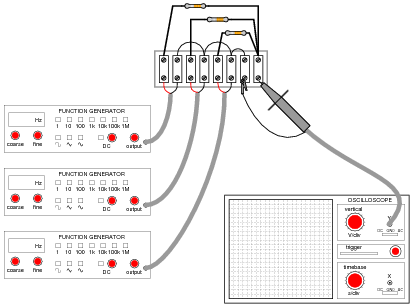
Draw a schematic diagram of this circuit, to make it easier to analyze.
Is it possible to filter the three constituent input signals from each other in the resulting output signal, or are they irrevocably affected by one another when they “mix” together in this resistor network? How does the superposition principle relate to the operation of a mixer circuit like this?
What if the mixing circuit contains capacitors and inductors rather than resistors? Does the same principle apply? Why or why not?
Reveal answer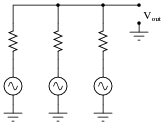
The “superposition principle” states that when two or more waveforms mix together in a linear network, the result is the sum of the waveforms. That is, the waveforms simply add up to make a total, and are not “irrevocably affected” by one another. The question, then, is really: what constitutes a linear network?
Notes:It is no coincidence that the “superposition principle” sounds a lot like the “superposition theorem” learned as a network analysis technique: consider the effects of all power sources one at a time, and add those effects together to determine the final result.
The matter of “irrevocable influence” is important to us because it dictates how difficult it would be to separate the mixed signals from each other. When external noise couples to a circuit through capacitive or inductive coupling, can we filter out the noise and obtain the true signal again, or has the signal been corrupted in such a way that restoration is impossible by mere filtering? The key to answering this question is whether or not the “network” formed from parasitic capacitive/inductive coupling is linear. Discuss with your students what determines linearity in a math equation, and apply these criteria to the equations describing resistor, capacitor, and inductor behavior.
-
Question 30 of 31
What is a musical chord? If viewed on an oscilloscope, what would the signal for a chord look like?
Reveal answerA chord is a mixture of three of more notes. On an oscilloscope, it would appear to be a very complex waveform, very non-sinusoidal.
Note: if you want to see this form yourself without going through the trouble of setting up a musical keyboard (or piano) and oscilloscope, you may simulate it using a graphing calculator or computer program. Simply graph the sum of three waveforms with the following frequencies:
- 261.63 Hz (middle “C”)
- 329.63 Hz (Ë”)
- 392.00 Hz (“G”)
Notes:Students with a musical background (especially piano) should be able to add substantially to the discussion on this question. The important concept to discuss here is that multiple frequencies of any signal form (AC voltage, current, sound waves, light waves, etc.) are able to exist simultaneously along the same signal path without interference.
Related Tools:
- Intermediate Electromagnetism and Electromagnetic Induction
- Performance-Based Assessments for Network Analysis Competencies