
 Facebook
 Google
 GitHub
 Linkedin
AC Electric Circuits
Mixed-Frequency Signals
31 questions By Tony R. Kuphaldt
-
Question 4 of 31
Identify the type of electronic instrument that displays the relative amplitudes of a range of signal frequencies on a graph, with amplitude on the vertical axis and frequency on the horizontal.
Reveal answerA spectrum analyzer.
Challenge questions: two similar instruments are the wave analyzer and the Fourier analyzer. Explain how both these instruments are similar in function to a spectrum analyzer, and also how both differ.
Notes:Spectrum analyzers capable of analyzing radio-frequency signals are very expensive, but low-cost personal computer hardware and software does a good job of analyzing complex audio signals. It would be a benefit to your class to have a low-frequency spectrum analyzer setup available for student use, and possible demonstration during discussion.
-
Question 5 of 31
Suppose an amplifier circuit is connected to a sine-wave signal generator, and a spectrum analyzer used to measure both the input and the output signals of the amplifier:
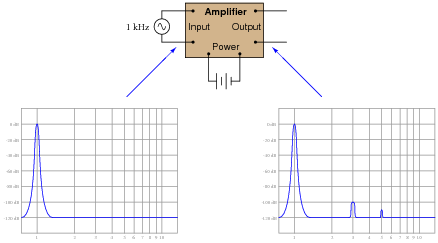
Interpret the two graphical displays and explain why the output signal has more “peaks” than the input. What is this difference telling us about the amplifier’s performance?
Reveal answerThe input signal is clean: a single peak at the 1 kHz mark. The amplifier’s output, on the other hand, is a bit distorted (i.e. no longer a perfect sine-wave shape as the input is).
Notes:The purpose of this question is to get students to realize the presence of harmonics means a departure from a once-perfect sinusoidal wave-shape. What used to be free of harmonics now contains harmonics, and this indicates distortion of the sine wave somewhere within the amplifier.
By the way, the perfectly flat “noise floor” at -120 dB is highly unusual. There will always be a “rough” floor shown on the display of a spectrum analyzer, but this is not pertinent to the question at hand so I omitted it for simplicity’s sake.
-
Question 6 of 31
What causes harmonics to form in the output of a transistor amplifier circuit, if the input waveform is perfectly sinusoidal (free from harmonics)? Be as specific as you can in your answer.
Reveal answerAny feature (or fault) of the circuit causing imperfect signal reproduction will necessarily create harmonics, for it will turn a perfectly sinusoidal input signal into a distorted (non-perfect-sinusoidal) signal.
Notes:Discuss with your students the nature of harmonics: how multiple sinusoidal waveforms are necessarily contained in any periodic waveform that is not perfectly sinusoidal itself.
Related Tools:
- Intermediate Electromagnetism and Electromagnetic Induction
- Performance-Based Assessments for Network Analysis Competencies


